Last Updated: August 21, 2026
Planning a Greece itinerary 7 days long? A week is enough time to stand under the Parthenon, walk the stadium where the first Olympics were run, and climb to the monasteries balanced on the rock towers of Meteora. What it isn’t enough time for is doing all of that and island-hopping.
So this guide picks the route that a week actually rewards, a loop through mainland Greece from Athens. It runs south into the Peloponnese for Mycenae and Nafplio, west across the mountains to Ancient Olympia, north over the Gulf of Corinth to Delphi, and up to Meteora before turning back to the capital.
The whole thing is built around a campervan picked up in Athens, which rolls your transport and your bed into one booking. Greek archaeological sites sit in villages and valleys with almost no public transport, so the van is what turns a scattered map into a single drive.
Key Takeaways
- Iconic stops: the Acropolis in Athens, Ancient Olympia, and the monasteries of Meteora are the three you build the week around.
- Hidden gems: the stone mountain villages of Stemnitsa and Dimitsana in Arcadia, and the Venetian harbor at Nafpaktos.
- Recommended transport: a campervan rental from Indie Campers, picked up in Athens, since the ancient sites on this route are poorly served by buses and trains.
- Recommended budget: €600 to €1,200 per person for the seven days, plus the campervan hire, covering campsites, fuel, tolls, food, and site entry.
- Best time to go: spring (April to June) or autumn (September to October) for warm days, open campsites, and manageable crowds.
Greece Itinerary 7 Days at a Glance
| Day | Area | Top Highlights |
| Day 1 | Athens: the Acropolis | Parthenon, Erechtheion, Acropolis Museum, Plaka, Anafiotika. Try souvlaki and horiatiki salad. |
| Day 2 | Athens to Cape Sounion | Ancient Agora, National Archaeological Museum, Temple of Poseidon at sunset. Try grilled octopus. |
| Day 3 | Corinth to Nafplio | Corinth Canal, Ancient Corinth, the Lion Gate at Mycenae, Palamidi fortress. Try moussaka. |
| Day 4 | Epidaurus, Arcadia, and Olympia | Theater of Epidaurus, the mountain villages of Stemnitsa and Dimitsana. Try hilopites. |
| Day 5 | Olympia to Delphi | Olympia’s stadium and museum, the Rio-Antirrio bridge, Nafpaktos harbor. Try kleftiko. |
| Day 6 | Delphi to Meteora | Sanctuary of Apollo, the Charioteer, Arachova, sunset over Kastraki. Try formaela cheese. |
| Day 7 | Meteora to Athens | Cliff-top monasteries, Thermopylae, a farewell dinner in Psiri. Try bougatsa. |
Table of Contents
- Why You’ll Love a 7-Day Road Trip in Greece
- Best Time to Visit Greece
- Are 7 Days Enough to See Greece?
- Should Your 7 Day Greece Itinerary Include the Islands?
- How to Get Around Greece
- The Best Greece Itinerary 7 Days, Day by Day
- Alternative 7 Day Greece Itineraries
- Map of Your 7-Day Greece Route
- Driving a Campervan in Greece: Tolls, Fuel, and Rules
- The Best Campsites on This Route
- What to Pack for a Greek Road Trip
- Budgeting for Your Trip: How Much Does 7 Days in Greece Cost?
- Plan Your Greece Road Trip with Indie Campers
- Greece Itinerary 7 Days: Planning Recap
- Frequently Asked Questions (FAQs)
Why You’ll Love a 7-Day Road Trip in Greece
Most one-week Greece plans put you on a plane or a ferry to Santorini by day three, which means a third of the week goes on transit. Driving the mainland instead keeps every hour on the ground, and it puts five of the country’s headline ancient sites inside a loop you can close in seven days. Our Italy 7-day itinerary works the same way across the Adriatic.
Greece carries 21 World Heritage Sites on the UNESCO list, and this route strings together the Acropolis, Mycenae, Epidaurus, Olympia, Delphi, and Meteora. Nowhere else in Europe packs that much recorded history into 1,300 km of road, and the drives between them are short enough that no day is spent only behind the wheel.
The country is also busier than most people expect, which is the strongest argument for going in shoulder season. Greece drew 128 million nights from international visitors in 2024, the fourth-highest total in the EU, and almost all of it lands between June and September. Travel in May or late September and the same sites are half as crowded.
Then there’s the food, which changes as the road climbs. You go from souvlaki and grilled octopus at sea level in Athens, to the slow-cooked lamb and wild greens of the Arcadian mountains, to the smoked formaela cheese they fry at the table around Delphi and Meteora. A van with a fridge and a market stop every morning is how you eat all of it properly.
Best Time to Visit Greece
Season shapes this trip more than anything else, from midday heat at the ruins to whether the campsites on the route are even open. Here’s what each window means for a mainland loop.
Spring (April to June)
Spring is the best all-round window for this route. Wildflowers cover the Peloponnese, the archaeological sites are comfortable to walk at midday, and campsites reopen from April onwards after the winter break.
Average Temperatures: 15 to 28°C (59 to 82°F)
What to expect: warm days, green hills, moderate crowds, mid-range prices. Orthodox Easter is the one peak to plan around.
Summer (July to August)
Summer brings heat rather than crowds as the main problem. Inland sites like Olympia and Delphi have almost no shade, and during extreme heat the Acropolis has closed to visitors for a few hours in the afternoon, so check on the day before you set out.
Average Temperatures: 30 to 38°C (86 to 100°F)
What to expect: hot afternoons, packed campsites, top prices. Start walking sites at opening and rest between 1pm and 5pm.
Autumn (September to October)
Autumn is the close rival to spring, and arguably better if you want a swim. The sea stays warm into October, the olive and grape harvests are underway, and tour bus traffic at the big sites drops sharply after the first week of September.
Average Temperatures: 18 to 30°C (64 to 86°F)
What to expect: warm days, warm sea, thinning crowds, lower prices than summer.
Winter (November to March)
Winter halves the price of the headline sites and empties them, which is a real trade if you don’t mind the cold. Entry to the Acropolis drops to about €15 from November to March, though Meteora can get snow and many campsites on this route close until spring.
Average Temperatures: 8 to 16°C (46 to 61°F)
What to expect: cool, sometimes wet days, half-price entry, few crowds, and limited campsite options. Call ahead before you rely on any site being open.
Are 7 Days Enough to See Greece?
Seven days is enough to see mainland Greece properly, and not enough to add the islands on top. This route gives you two days in and around Athens and five on the road, which covers the ancient sites that define the country without a single wasted morning.
That balance is what makes it a good 7-day Greece itinerary for first timers. You get the story in order, from Bronze Age Mycenae through classical Athens and Delphi to the Byzantine monasteries of Meteora, so each stop builds on the last rather than blurring into another pile of ruins.
If you only have three or four days, the first three stand alone as a self-contained Athens and Peloponnese trip, and you can skip the drive north. If you’re weighing Greece against another one-week road trip on this side of Europe, our Croatia 7-day itinerary covers a coast-and-national-park route instead.
What you trade for the pace is depth. You see each site once, on one visit, and you don’t get a slow beach week. Add three days and the same loop stretches comfortably to include Mystras, the Mani peninsula, or a night on Pelion.
Should Your 7 Day Greece Itinerary Include the Islands?
Probably not, and the reason is arithmetic rather than taste. The fast ferry from Piraeus to Santorini runs about 5 hours each way and the conventional boat closer to 8, so a return trip eats a full day and a half of a seven-day week before you’ve seen anything.
Flying cuts the water time to about 45 minutes, but you still lose most of two half-days to airports, and you leave the van parked at the depot while you pay for hotels. For a single week, either one island paired with Athens or the full mainland loop works well. Trying to do both is how people come home saying Greece felt rushed.
There is a middle path if you want a taste of island life without losing a day to it. The Saronic islands sit close enough to Athens for a return day trip, with fast ferries reaching Aegina in around 40 minutes and Hydra in about 1 hour 30 from Piraeus, so you can swap out Cape Sounion on Day 2 and still sleep in the van that night.
How to Get Around Greece
Greek trains and buses connect the cities well and the ancient sites badly. Mycenae, Epidaurus, Olympia, and Delphi all sit outside their nearest town, and reaching them by public transport usually means a bus to a village and a taxi from there, with a return timed around one departure a day.
A campervan solves that and the accommodation problem at once. You park at a licensed campsite near each site, wake up 10 minutes from the gate, and cook breakfast instead of hunting for it. Indie Campers runs RV rental in Athens with pick-up in the city, so the van is ready the day you land.
The fleet ranges from compact campervans for couples to larger motorhomes for families, which matters on a route with narrow mountain roads through Arcadia. Company-owned vehicles come with unlimited mileage, and this loop covers roughly 1,300 km, so a per-kilometer cap would show up on the bill.
Booking terms take the pressure off the planning. Flexible cancellation up to 31 days before pick-up and the book-now-pay-later option, which holds the reservation until 30 days before you collect the van, let you lock in summer dates without paying for them yet.
The Best Greece Itinerary 7 Days, Day by Day
Here’s the full plan, day by day. Each one covers a morning, afternoon, and evening, with entry prices, named tavernas, a campsite for the night, and one practical tip for traveling by van. Collect your campervan rental in Athens on the morning of Day 1 and leave it at the campsite while you do the city on foot and by Metro.
Day 1: Athens and the Acropolis
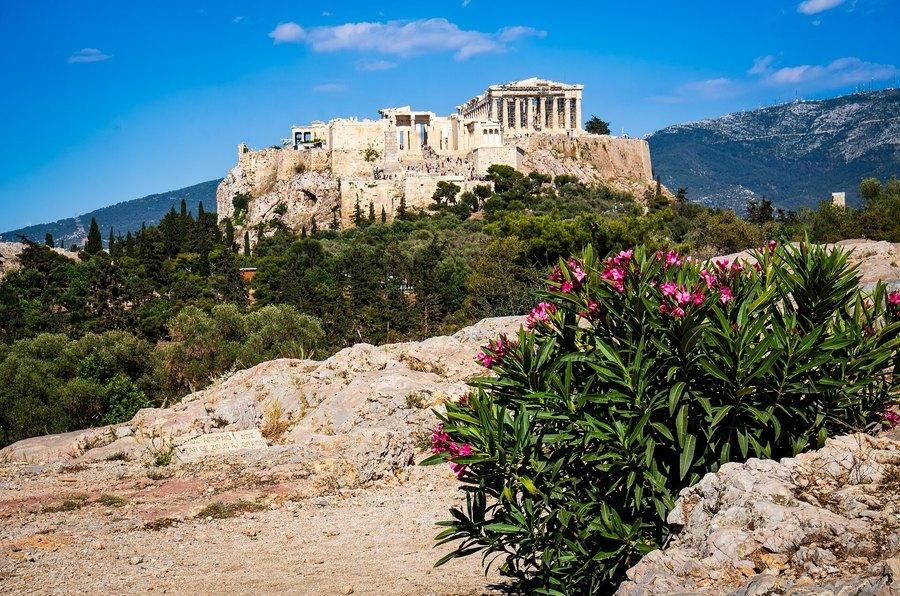
Morning (8:00 AM): The Acropolis
Book the first timed slot of the day and be at the gate before it opens. Entry runs about €30 from April to October, and about €15 from November to March, and peak-season slots sell out days ahead, so buy online rather than turning up.
Go up through the Propylaea to the Parthenon, then look for the Erechtheion with its six Caryatids and the small Temple of Athena Nike on the bastion above the entrance. Come down the south slope past the Theater of Dionysus, where Greek tragedy was first staged.
Practical tip: don’t drive into central Athens. Park at Camping Athens on Leoforos Athinon and take the bus and Metro Line 2 to Akropoli station, which puts you a 5-minute walk from the south entrance.
Afternoon (1:00 PM): Acropolis Museum, Plaka, and Anafiotika
The Acropolis Museum sits at the foot of the hill and costs around €15 in high season. Its top floor lays out the Parthenon frieze at full scale in daylight, with the missing sections marked, which is the clearest explanation of the building you’ll get anywhere.
Walk north into Plaka for lunch, then up into Anafiotika, the pocket of whitewashed island-style houses built into the rock by masons from Anafi. For food, head to the Central Market district instead of the tourist strip. Diporto, a basement taverna on the corner of Sokratous and Theatrou with no sign and no menu, serves chickpeas, sardines, and wine from the barrel.
Evening (7:00 PM): Sunset and Dinner in Psiri
Climb Areopagus Hill for sunset over the Acropolis, which is free and better than any rooftop bar. Then walk down into Psiri for dinner. Ta Karamanlidika tou Fani, at Sokratous 1 on the corner of Evripidou, is a deli and mezze counter built around cured meats and cheeses, and the pastourma and grilled halloumi are what to order.
Day 2: Ancient Athens and Cape Sounion
Morning (9:00 AM): Ancient Agora and the National Archaeological Museum
Start in the Ancient Agora, the marketplace where Socrates argued and the assembly met, for around €10. The Temple of Hephaestus here is the best-preserved Doric temple in Greece, and the rebuilt Stoa of Attalos houses the site museum.
Then take the Metro up to the National Archaeological Museum, about €12, which is the single best museum on this route. The gold Mask of Agamemnon from Mycenae, the bronze Artemision god pulled from the sea, and the corroded gears of the Antikythera Mechanism are all here, and Day 3 makes far more sense once you’ve seen them.
Practical tip: most state archaeological sites and museums in Greece keep shorter winter hours from November, and a few close one day a week, so check the day’s opening times the night before rather than on arrival.
Afternoon (3:00 PM): The Coast Road to Cape Sounion
Collect the van and drive south along the Athens Riviera, about 70 km and 1 hour 15 to Cape Sounion. The road runs past the marinas of Glyfada and Vouliagmeni and then out along open coast, with swimming coves signposted the whole way, so pack a towel on top.
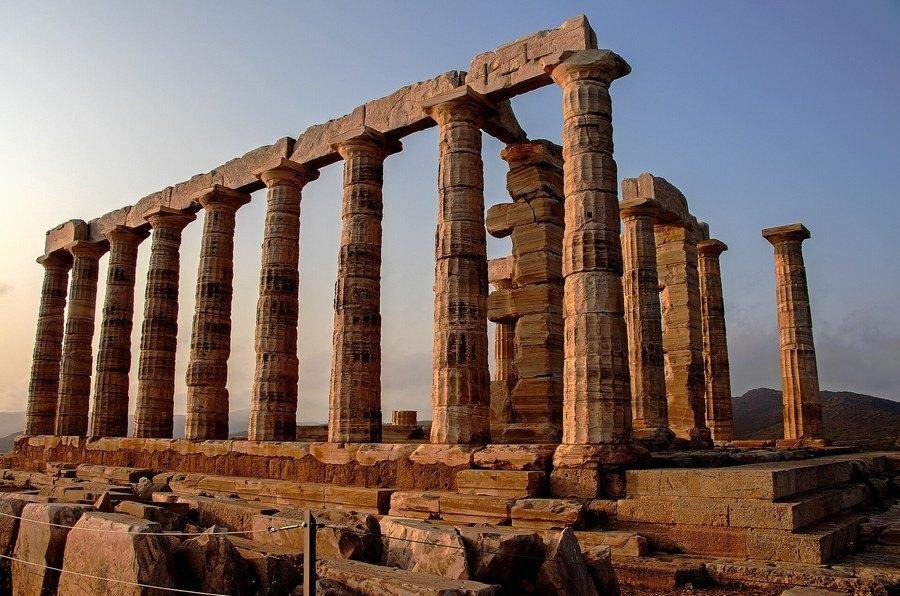
Evening (7:30 PM): Temple of Poseidon at Sunset
The Temple of Poseidon stands on a headland 60 m above the sea, and entry is around €10. Time it for the last hour before sunset, when the marble turns gold and the Saronic islands stack up on the horizon.
Stay the night at Camping Bacchus, a few minutes from the temple near Sounio, and eat at one of the fish tavernas in the village of Legrena just down the road, where the catch is chalked up daily and grilled octopus is the thing to order.
Day 3: The Corinth Canal, Mycenae, and Nafplio
Morning (9:00 AM): Corinth Canal and Ancient Corinth
Drive west on the A8 to the Corinth Canal, about 120 km from Sounion. The canal is a 6 km slot cut 80 m deep through solid rock, and the old road bridge gives you the view straight down it that the photos never quite capture.
Carry on 8 km to Ancient Corinth, around €8, for the Temple of Apollo and the market where Saint Paul preached. The Acrocorinth fortress on the mountain above is free and the drive up is worth it for the view over two gulfs.
Afternoon (1:00 PM): The Lion Gate at Mycenae
Mycenae is 50 km south, and it’s the oldest thing on this route by a thousand years. Entry is about €12 and covers the citadel and the museum. Walk in under the Lion Gate, the oldest monumental sculpture in Europe, then down into the beehive dome of the Treasury of Atreus, a chamber built without mortar around 1250 BC.
Practical tip: the site is exposed rock with no shade and the grave circles are a scramble, so bring water and proper shoes, and refill the van’s tank in Fichti before the climb.
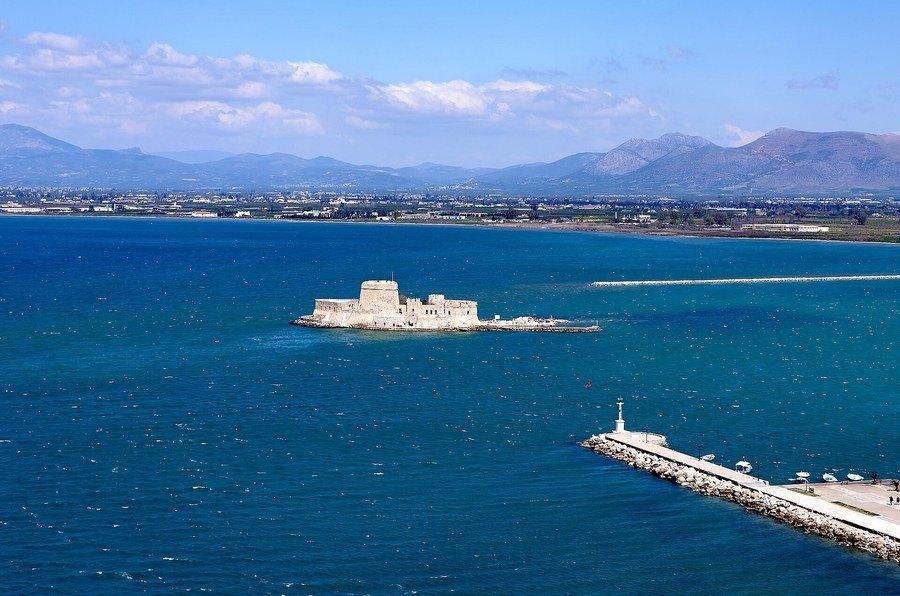
Evening (6:00 PM): Palamidi and Nafplio Old Town
Drive 25 km to Nafplio, the first capital of modern Greece and the prettiest town on the route. The Palamidi fortress above it, about €8, is a Venetian citadel reached by a staircase of nearly a thousand steps, or by a road that takes the van most of the way up.
Sleep at Camping New Triton on Plaka beach at Drepano, about 12 km east of town. For dinner, Ta Fanaria on Bouboulinas serves Peloponnesian home cooking, and To Omorfo Tavernaki, on the corner of Kotsonopoulou and Vasilissis Olgas, does a moussaka worth the drive back into town.
Day 4: Epidaurus, the Arcadian Mountains, and Olympia
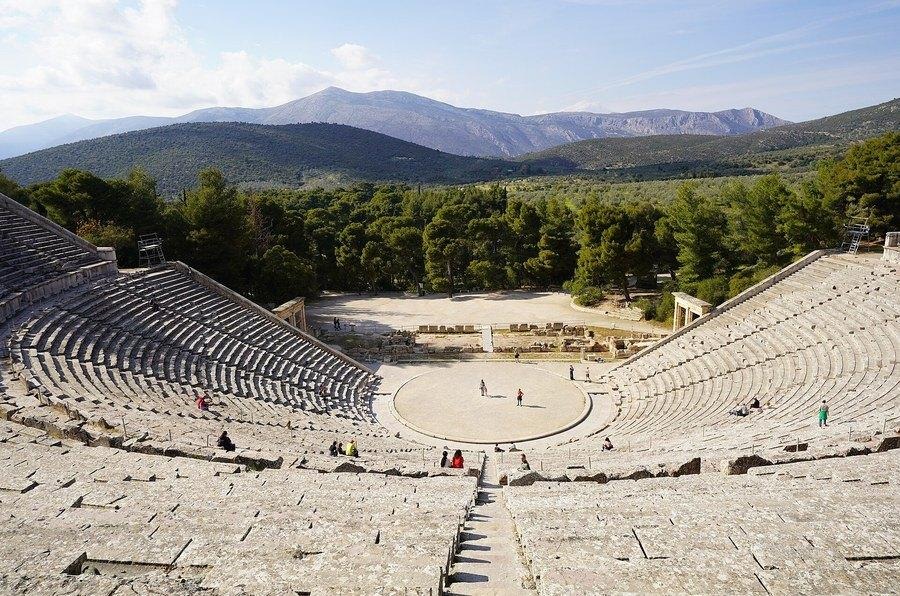
Morning (9:00 AM): The Theater of Epidaurus
Epidaurus is 30 km from Nafplio, about €12 with the museum, and it holds the best-preserved ancient theater in Greece. Its acoustics are the reason to go early, before the tour buses arrive. From the top row, 55 tiers up, you can hear a coin dropped on the orchestra floor.
The rest of the site was a healing sanctuary, a kind of ancient hospital complex, and the museum’s surgical instruments make that far more vivid than the ruins do.
Afternoon (12:30 PM): Stemnitsa and Dimitsana
Now turn inland, and this is where the van earns its keep. The road climbs through Tripoli into Arcadia, where Stemnitsa and Dimitsana sit on facing slopes above the Lousios gorge, stone villages of slate roofs and silversmiths that almost no one on a seven-day Greece trip ever sees.
Stop for lunch in either main square. The mountain cooking here runs to hilopites, the hand-cut egg pasta, with slow-cooked goat or rooster, and it’s a different country from the seafood you ate yesterday.
Practical tip: the Arcadian roads are well surfaced but narrow with tight hairpins, so take them in a low gear and give yourself an extra 30 minutes over what the map says.
Evening (6:30 PM): Arrive in Ancient Olympia
Drop down west to Ancient Olympia, about 95 km from Dimitsana. Settle at Camping Diana, which sits in the village within walking distance of the site entrance, and take the evening slowly.
Eat at Taverna Bacchus in the hill village of Ancient Pissa, 3 km up the road, where the kitchen cooks whatever is in season, or at Aegean on Georgiou Douma in the village itself, which has the longest vegetarian list in the village.
Day 5: Ancient Olympia and the Road to Delphi
Morning (8:30 AM): The Sanctuary of Olympia
A combined ticket for the site and its museum runs about €12. Walk in through the gymnasium and the workshop of Pheidias, then out along the vaulted tunnel the athletes used to enter the stadium, which still has its stone start and finish lines 192 m apart.
The museum is the reason to allow three hours rather than one. It holds the pediments of the Temple of Zeus, the Nike of Paionios, and Praxiteles’ Hermes, all of them carved for a sanctuary that ran the games for over a thousand years.
Practical tip: run the stadium length once. It’s allowed, it’s the original track, and it takes 30 seconds.
Afternoon (1:30 PM): The Rio-Antirrio Bridge and Nafpaktos
Drive north to Patras and cross the Gulf of Corinth on the Rio-Antirrio bridge, a 2.9 km cable-stayed span that saves you the ferry crossing. It’s tolled by vehicle size, so a motorhome pays more than a car, and the booths take cards.
Stop in Nafpaktos on the far side for coffee in its circular Venetian harbor, which is enclosed by medieval walls and small enough to walk around in 20 minutes.
Evening (6:00 PM): Arrive in Delphi
Delphi is another 120 km east on a road that hugs the north shore of the gulf. Delphi Camping sits just west of the village at Chrisso, on a terrace with a long view down the olive valley to the sea.
Walk into the village for dinner. Taverna Vakhos at Apollonos 31 is the reliable choice for lamb kleftiko and mountain greens, and Epikouros on Vasileon Pavlou and Friderikis has the better view from its terrace.
Day 6: Delphi and the Drive to Meteora
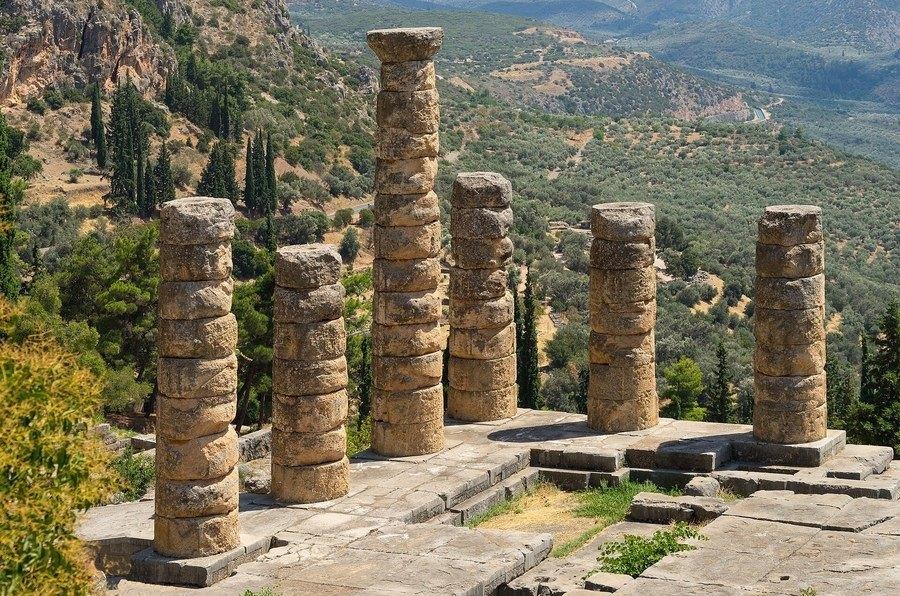
Morning (8:30 AM): The Sanctuary of Apollo
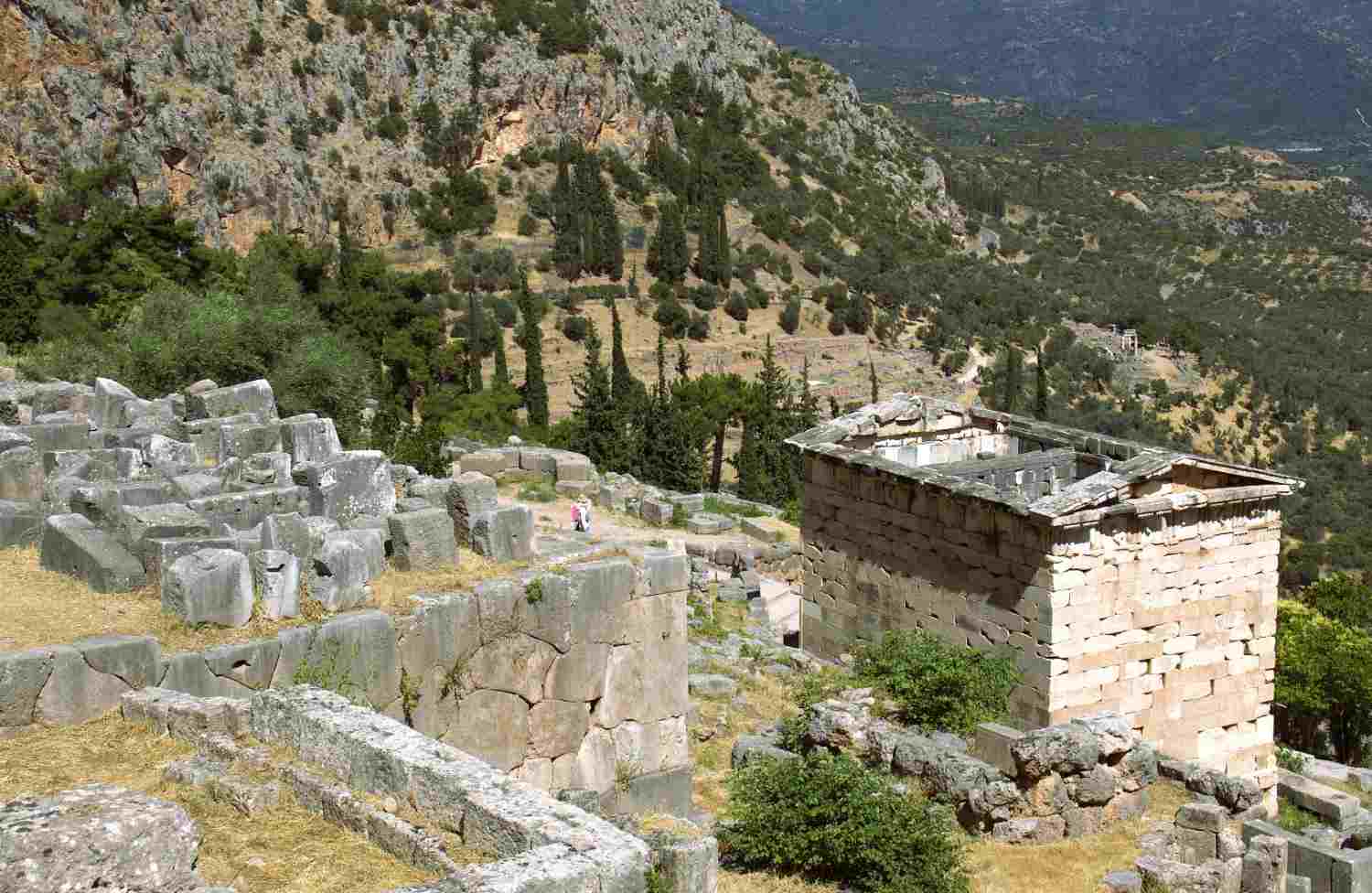
Delphi was the place the Greek world came for answers, and a combined site and museum ticket runs about €12. The Sacred Way climbs past the treasuries of the city-states to the Temple of Apollo, where the oracle spoke, and on up to the stadium cut into the mountain above.
In the museum, find the Charioteer, a life-size bronze from 470 BC whose inlaid eyes still track you across the room. Then walk 10 minutes east to the Tholos of Athena Pronaia, the round temple below the road that most visitors photograph and never actually reach.
Practical tip: the site is one long slope, so start at the top gate and walk down if you can, and fill your water bottles at the Castalian Spring stop between the two halves of the site.
Afternoon (1:00 PM): Arachova and the Drive North
Climb 12 km to Arachova, a mountain town on the flank of Parnassos, for lunch and a wheel of formaela, the hard sheep’s cheese they slice thick and fry until it squeaks. The shops along the main street sell it alongside honey and hand-woven rugs.
Then it’s about 230 km north to Meteora, through Lamia and up the Thessalian plain. The drive takes roughly 3 hours and the last 20 minutes are the payoff, as the rock towers rise out of flat farmland with no warning at all.
Evening (7:00 PM): Sunset at Kastraki
Base yourself at Camping Vrachos in Kastraki, which sits directly beneath the rocks with pitches looking straight up at them. Drive or walk up to the Psaropetra viewpoint for sunset, when the monasteries go orange, and the valley below fills with haze.
Eat in the village at Taverna Gardenia on Agiou Athanasiou, where the terrace faces the rocks, or drive 2 km into Kalambaka for Taverna Panellinio on Plateia Dimarcheiou, open since 1950 and still the best-value grill in town.
Day 7: The Monasteries of Meteora and Back to Athens
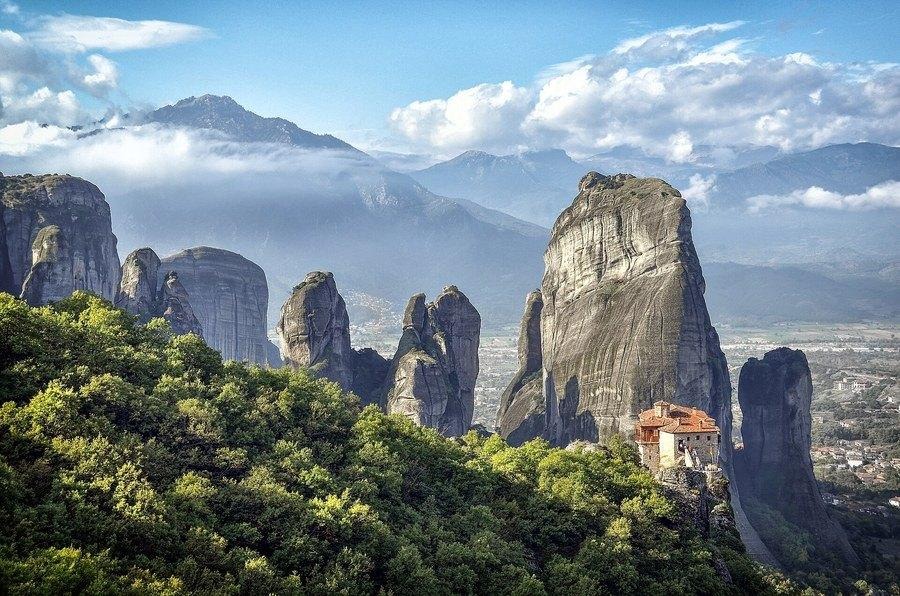
Morning (8:00 AM): The Cliff-Top Monasteries
Six monasteries are still active on the Meteora rocks, and entry is €5 each in cash. Great Meteoron is the largest and has the best museum, Varlaam the finest frescoes, and Rousanou and Holy Trinity the most dramatic approaches, with Holy Trinity reached by 140 steps cut into the rock.
Each monastery closes on a different day of the week and the days change between summer and winter, so check the current schedule before you plan the loop. Two or three monasteries fill a morning, and a modest dress code applies, meaning covered shoulders, long trousers for men, and a skirt below the knee for women, with wraps lent at the gate.
Practical tip: the monastery road is narrow with sheer drops and few passing places, so start at 8 am before the tour buses begin their circuit, or leave the van at the campsite and take the footpath up from Kastraki instead.
Afternoon (1:00 PM): South to Thermopylae
The drive back to Athens is about 355 km and 4 hours 15 on the E65 and A1. Break it at Thermopylae, right beside the motorway, where the Leonidas monument and the modern information center mark the pass the 300 Spartans held in 480 BC.
Evening (7:30 PM): A Last Night in Athens
Return to Camping Athens for the final night, and go back into Psiri or Monastiraki for dinner. Order gyros from a counter, then bougatsa, the custard pastry dusted with cinnamon and sugar, from a bakery on the walk back to the Metro.
Practical tip: leave a buffer before your drop-off slot in Athens, and return the van with a full tank, an empty waste tank, and a clean kitchen to avoid extra charges.
Alternative 7 Day Greece Itineraries
The loop above is the balanced Greece 7-day itinerary, five ancient sites and one Byzantine one, all reachable by road. Here are two ways to reshape the same week.
The Athens and One Island Route
- Days 1 to 3: Athens and Cape Sounion as above, based at a campsite on the edge of the city.
- Day 4: leave the van at the campsite and take the fast ferry from Piraeus to Aegina or Hydra for a day on the water.
- Days 5 to 7: drive the Peloponnese leg only, with Corinth, Mycenae, and two nights in Nafplio, and skip the drive north entirely.
The Slow Peloponnese Route
- Days 1 to 2: Athens, then south to Nafplio for Mycenae and Epidaurus.
- Days 3 to 5: continue south through Mystras, the Byzantine city below Sparta, to Monemvasia and the stone towers of the Mani peninsula.
- Days 6 to 7: north to Ancient Olympia, then back to Athens. To fold Greece into a longer trip across the continent, our 2-week Europe itinerary picks up the same road-trip logic further west.
Map of Your 7-Day Greece Route
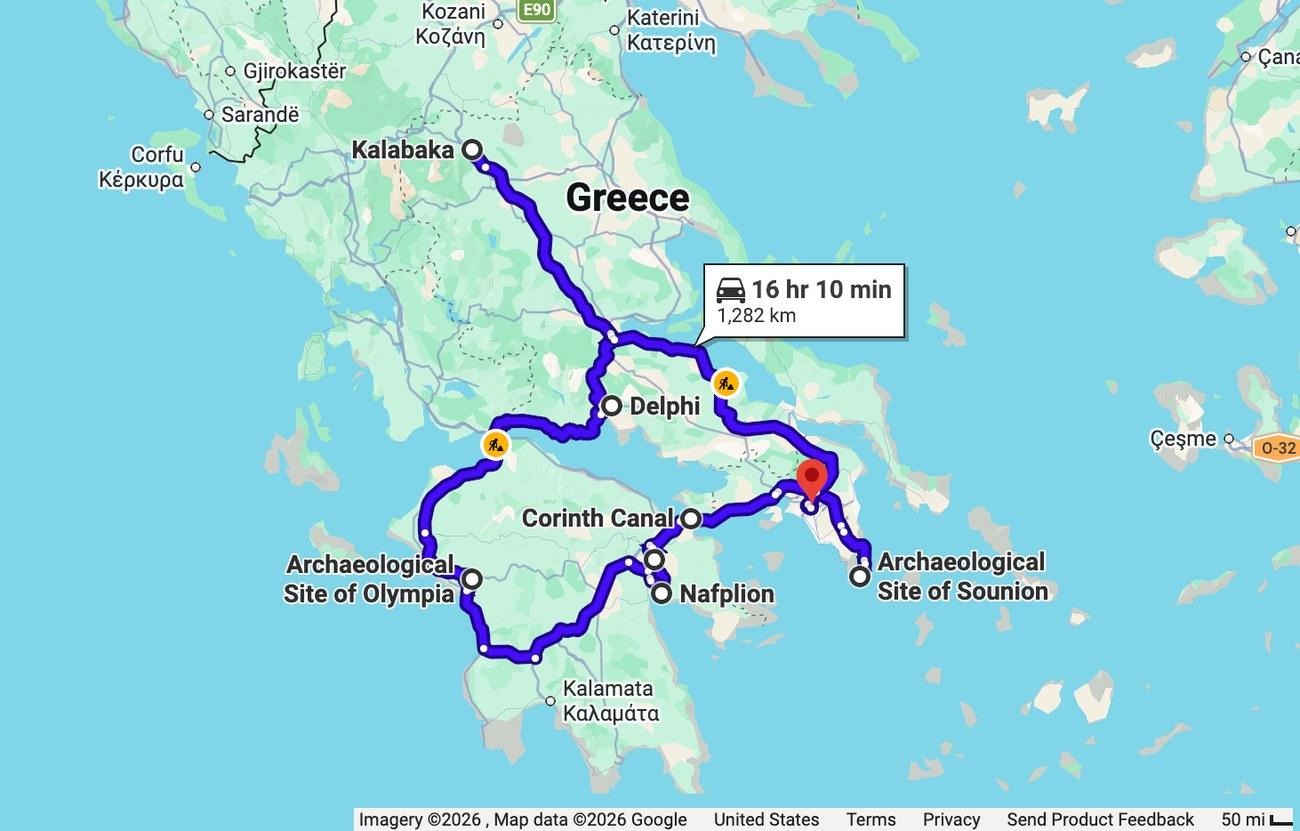
The route is a wide counterclockwise loop from Athens. It runs south to Cape Sounion, west through Corinth to Nafplio, inland across Arcadia to Olympia, north over the Rio-Antirrio bridge to Delphi, up the Thessalian plain to Meteora, and back down the A1 to the capital.
Total driving comes to roughly 1,300 km (810 miles), and the longest single day is the return leg. Our wider RV rental in Greece coverage picks up the rest of the country if you want to extend north to Zagori or Thessaloniki.
Driving a Campervan in Greece: Tolls, Fuel, and Rules
Greek roads are better than their reputation, and the motorway network on this route is modern throughout. A few local rules are worth knowing before you collect the van, because they change how you plan each day.
- Motorway tolls: the A8 to Corinth, the A7 south to the Peloponnese, and the A1 north all charge at booths rather than by sticker, and campervans usually fall into a higher category than cars. Keep €30 to €40 in cash for the week alongside a card.
- Fuel: gas prices in Greece are among the highest in the EU, and stations thin out in the mountains. Fill up in Tripoli, Patras, and Lamia rather than trusting the next village to have a pump.
- Village roads: the older national roads through Arcadia and around Delphi narrow to a single lane through villages with parked cars on both sides. A compact van makes those stretches far less stressful than a large motorhome.
- Free camping: camping outside a licensed campsite is not permitted in Greece, including on beaches and in parking lots, and it’s enforced in popular areas. Plan every night around an official site.
- Site parking: most archaeological sites have a free or low-cost parking lot that takes a van, but arrive early because the tour buses take the shaded end first.
The Best Campsites on This Route
Every night on this route has a licensed campsite within easy reach of that day’s sights, which is what keeps the driving days short. These five cover the whole loop, and all of them take motorhomes and have electric hook-up.
Camping Athens
The closest full-service site to the city center, on Leoforos Athinon west of the Acropolis, with a bus stop outside and the Metro a short ride away. It’s open all year, which makes it the reliable choice for the first and last nights.
Camping Bacchus, Sounio
A small terraced site minutes from the Temple of Poseidon, with sea views from the upper pitches and swimming coves below. It turns Day 2’s sunset into a 5-minute walk rather than a night drive back to Athens.
Camping New Triton, Drepano
On Plaka beach about 12 km east of Nafplio, which puts you between Mycenae and Epidaurus with a swim at the end of both days. Pitches are shaded, and each has its own power point.
Camping Diana, Ancient Olympia
The long-established site in Olympia village, close enough to walk to the sanctuary gate before it opens. Being able to reach a major site on foot at 8 am is the whole argument for a campervan on this route.
Camping Vrachos, Kastraki
Directly beneath the Meteora rocks, with pitches that look straight up at the monasteries and a footpath from the site into the village. Open since 1965 and still the obvious base for the Meteora day.
What to Pack for a Greek Road Trip
Greece asks for a slightly different kit list than a city break, mostly because you spend the days walking uneven ancient stone and the nights in a van.
- Proper walking shoes: Mycenae, Delphi, and the Palamidi steps are all loose rock and worn marble, and sandals will end that day early.
- Sun cover: a hat, high-factor sunscreen, and a refillable bottle, since Olympia and Mycenae have almost no shade and few taps.
- Modest layer: a scarf or light long-sleeve for the Meteora monasteries and any church, and a warm layer for mountain evenings even in July.
- Cash: monastery entry, some tolls, and village tavernas are cash-only, so carry small notes rather than relying on cards.
- Swim kit at the top of the bag: the coast road, Plaka beach, and the Gulf of Corinth all offer a swim you’ll want without unpacking the van.
Budgeting for Your Trip: How Much Does 7 Days in Greece Cost?
A week in mainland Greece is cheaper than the same week in Italy or France, and the campervan is the biggest reason. Swapping seven hotel nights for campsite pitches cuts your single largest cost to a fraction, and cooking two meals a day in the van does the same to the second largest.
Here’s a realistic per-person breakdown, not counting the campervan hire itself.
| Category | Budget | Mid-Range | High-End |
| Campsite Pitch | €12 to €18/night | €18 to €30/night | N/A (hotels) |
| Food & Drink | €20 to €30/day | €35 to €60/day | €90+/day |
| Sites & Museums | €10 to €20/day | €20 to €35/day | €50+/day |
| Fuel & Tolls | €12 to €20/day | €20 to €30/day | €35+/day |
| Daily Total | €54 to €88 | €93 to €155 | €175+ |
| 7-Day Total | ~€380 to €615 | ~€650 to €1,085 | ~€1,225+ |
Budget traveler: shop the morning markets, cook in the van, and pair the paid headliners (the Acropolis, Olympia, Delphi) with the free ones like Acrocorinth and Areopagus Hill. Around €500 per person for the week is realistic.
Mid-range traveler: eat lunch out and one taverna dinner most days, pay for every site and museum on the route, and add the Acropolis Museum and the National Archaeological Museum. Budget €750 to €1,100 per person.
High-end traveler: eat out twice a day, book guided tours at Delphi and Meteora, and add a hotel night in Nafplio. Expect €1,300 or more per person.
One thing worth planning for is fuel, since it’s the line most people underestimate on this loop. At 1,300 km with mountain sections, budget a full tank and a half across the week and check the campervan hire in Greece mileage terms so a long drive day doesn’t cost extra.
Plan Your Greece Road Trip with Indie Campers
Seven days in Greece means two modes in one week, dense walking days among ancient stone and long open drives between them. The friction is usually the joins, six or seven separate hotel bookings in towns with awkward transport, plus buses and taxis to sites that were never built to be reached that way.
A campervan folds all of that into a single booking. You pick up in Athens, carry your bed and kitchen the whole loop, and sleep within walking distance of Olympia and under the rocks at Meteora. Company-owned vehicles come with unlimited mileage for the 1,300 km ahead, flexible cancellation up to 31 days before pick-up, and book-now-pay-later, so you can hold peak summer dates without paying for them yet.
Book your campervan and kickstart an adventurous Greece trip now!
Greece Itinerary 7 Days: Planning Recap
| Category | Details |
| Best Time to Go | Spring (April to June) and autumn (September to October) for warm days, open campsites, and thinner crowds. |
| Recommended Budget | €600 to €1,200 per person for 7 days, plus campervan hire. |
| Days in Athens | 2, including the Cape Sounion coast run. |
| Road Trip Days | 5, covering Corinth, Mycenae, Nafplio, Epidaurus, Arcadia, Olympia, Delphi, and Meteora. |
| Best Restaurants | Diporto, Athens (chickpeas and barrel wine); To Omorfo Tavernaki, Nafplio (moussaka); Taverna Vakhos, Delphi (kleftiko); Taverna Gardenia, Kastraki (grills with a rock view). |
| Recommended Transport | Campervan rental picked up in Athens, since the ancient sites have almost no public transport. |
| Total Driving | Approx. 1,300 km (810 miles), with the Meteora to Athens return the longest single leg. |
| Must-Try Foods | Souvlaki, grilled octopus, moussaka, hilopites, kleftiko, fried formaela, bougatsa. |
| Accommodation | Licensed campsites, €12 to €30 per pitch per night. |
| Perfect For | First-timers who want the ancient sites and the countryside rather than a beach week. |
Frequently Asked Questions (FAQs)
Is 7 days enough for Greece?
Seven days is enough for Greece if you pick either the mainland or one island group rather than both. A week comfortably covers Athens plus a loop through Mycenae, Nafplio, Olympia, Delphi, and Meteora, which is roughly 1,300 km of driving spread across five road days. Adding Santorini or Mykonos to the same week costs a day and a half in ferry or airport time. For a first trip, the mainland loop delivers more per day.
What is the best 7 day Greece itinerary for first timers?
The best 7-day Greece itinerary for first timers runs Athens, Cape Sounion, Corinth, Mycenae, Nafplio, Epidaurus, Ancient Olympia, Delphi, and Meteora, in that order. It follows Greek history in sequence, from Bronze Age Mycenae through classical Athens and Delphi to the Byzantine monasteries, so each site explains the next. Two days in Athens and five on the road keep every drive under 4 hours. A campervan makes it work, because most of those sites have no useful bus service.
Should you visit the Greek islands or the mainland in 7 days?
Visit the mainland in 7 days if the ancient sites and the countryside are the draw, and the islands if you want beaches and a slower pace. The mainland loop fits five UNESCO-listed sites into one drive with no transit days, while a Santorini return trip from Athens costs about 10 hours on a fast ferry. A compromise is Athens plus a Saronic island day trip, with Aegina about 40 minutes from Piraeus. That keeps the van and adds a day on the water.
How much does a 7-day trip to Greece cost?
A 7-day trip to Greece costs roughly €600 to €1,200 per person excluding the campervan hire and flights, based on campsites at €12 to €30 a pitch, food at €20 to €60 a day, and site entry at €10 to €35 a day. Budget travelers who cook in the van and mix free sites with the paid headliners come in nearer €500. Fuel and tolls add €12 to €30 a day on a 1,300 km loop. Travelling in May or October cuts campsite and ferry prices further.
Can you drive a campervan in Athens city center?
You should not drive a campervan into central Athens, because the historic core around Plaka and Monastiraki is a maze of narrow one-way streets with a weekday car restriction zone and almost no vehicle parking. The practical setup is a licensed campsite on the edge of the city, such as Camping Athens on Leoforos Athinon, and the Metro or bus in. Line 2 stops at Akropoli, a 5-minute walk from the south entrance to the Acropolis. Sites outside the city all have parking that takes a van.
Is wild camping allowed in Greece?
Wild camping is not allowed in Greece. Camping outside a licensed campsite is prohibited, including on beaches, in roadside pull-offs, and in parking lots, and it is actively enforced in popular coastal areas in summer. Every night of this route has a licensed site within easy reach of that day’s sights, from Camping Athens to Camping Vrachos beneath the Meteora rocks. Pitches run from about €12 to €30 a night with electric hook-up, which is still a fraction of a hotel room.
What is the best month to visit Greece?
May and late September are the best months to visit Greece for this route, with daytime temperatures of 20 to 28°C, open campsites, and far fewer tour buses at the big sites. July and August push inland sites like Olympia and Delphi past 35°C with no shade, and the Acropolis has closed for a few afternoon hours during extreme heat. Winter halves the Acropolis entry fee to about €15 but closes many campsites. April and October are the shoulder edges worth checking campsite opening dates for.
How far is Meteora from Athens by road?
Meteora is about 355 km from Athens by road, which takes roughly 4 hours 15 on the A1 and E65 motorways. Driving it as a return day trip means more than 8 hours behind the wheel, so it works far better as an overnight stop, which is how this itinerary handles it. Coming from Delphi instead cuts the leg to about 230 km and 3 hours. Kastraki and Kalambaka at the foot of the rocks both have campsites that take motorhomes.
Do you need a visa to visit Greece?
Visitors from the US, Canada, Australia, the UK, and most other non-EU countries do not need a visa for tourist stays in Greece of up to 90 days in any 180-day period. The EU’s ETIAS travel authorization is expected to launch in late 2026 and become mandatory the following year, at around €20 per application, so check the official EU guidance for your nationality before you book. EU citizens travel to Greece freely with a valid national ID card. Keep your passport valid for the whole trip and carry your driving licence for the van.