Last Updated: August 21, 2026
Planning a Greece itinerary 14 days long usually starts with a ferry timetable and ends in a panic about which islands to cut. There’s another way to spend the fortnight, and it’s the one most guides skip entirely.
This guide maps the mainland by campervan, in one loop out of Athens and back, covering the Acropolis, the Peloponnese’s ancient sites, the Mani’s tower villages, Olympia, Delphi, and the rock monasteries of Meteora.
That’s where a campervan earns its keep. You sleep beside the ruins and walk through the gate at opening, an hour before the coaches arrive from Athens.
Key Takeaways
- Iconic stops: the Acropolis, Delphi, and the Meteora monasteries are the three you don’t skip.
- Hidden gems: the tower villages of the Mani peninsula and ancient Messene, the largest excavated city site in Greece that almost nobody visits.
- Recommended transport: a campervan rental from Indie Campers, which combines your accommodation and transport in one booking and comes with unlimited mileage.
- Recommended budget: €1,100 to €1,800 per person for 14 days, plus the campervan hire, covering campsites, food, fuel, tolls, and entry tickets.
- Best time to go: late April to early June, or September to mid-October, for warm days, open campsites, and archaeological sites you can walk in comfort.
Greece Itinerary 14 Days: At a Glance
| Day | Area | Top Highlights |
| Day 1 | Athens | Acropolis at opening, the Parthenon, Plaka’s lanes, Anafiotika. Try a pork souvlaki. |
| Day 2 | Athens | Acropolis Museum, Ancient Agora, Monastiraki flea market, Panathenaic Stadium. Try loukoumades. |
| Day 3 | Athens Riviera & Cape Sounion | Lake Vouliagmeni, the coast road, Temple of Poseidon at sunset. Try grilled octopus. |
| Day 4 | Corinth, Mycenae & Nafplio | The Corinth Canal, Ancient Corinth, the Lion Gate, Nafplio’s Venetian old town. Try moussaka. |
| Day 5 | Nafplio & Epidaurus | Palamidi fortress, the theater at Epidaurus, Nafplio’s waterfront. Try gelato on Farmakopoulon. |
| Day 6 | Mystras & the Taygetos | The Byzantine hill city of Mystras, the drive over the Langada Pass. Try Laconian sausage. |
| Day 7 | The Mani Peninsula | Areopoli, the Diros Caves boat tour, Vathia’s tower houses, Cape Tainaron. Try Syglino. |
| Day 8 | Kardamyli & Ancient Messene | Kardamyli’s harbor, Kalamata, the excavated city of Messene. Try Kalamata olives. |
| Day 9 | Ancient Olympia | The stadium, the Temple of Zeus, the Hermes of Praxiteles. Try Elian pork with lemon. |
| Day 10 | Rio-Antirrio & Nafpaktos | The cable-stayed bridge crossing, Nafpaktos’s Venetian harbor. Try fresh Gulf fish. |
| Day 11 | Galaxidi & Delphi | Galaxidi’s sea captains’ houses, the sanctuary of Apollo, the charioteer. Try wild greens. |
| Day 12 | Arachova to Meteora | Arachova’s mountain lanes, the drive north through Thessaly. Try Meteora mushroom dishes. |
| Day 13 | The Meteora Monasteries | Great Meteoron, Varlaam, Roussanou, the sunset viewpoints above Kastraki. Try Thessalian pies. |
| Day 14 | Back to Athens | Thermopylae, the A1 run south, final Athens meal, campervan drop-off. Try bougatsa. |
Table of Contents
- Why You’ll Love a 14-Day Trip to Greece
- Best Time to Visit Greece
- Are 14 Days Enough to Visit Greece?
- How to Get Around Greece
- The Best Greece Itinerary: 14 Days Day by Day
- Alternative Greece Itineraries
- Map of Your 14-Day Greece Itinerary
- Budgeting for Your Trip: How Much Does 14 Days in Greece Cost?
- Plan Your Greece Road Trip with Indie Campers
- Greece Itinerary 14 Days: Your Final Planning Recap
- Frequently Asked Questions (FAQs)
Why You’ll Love a 14-Day Trip to Greece
Two weeks is the sweet spot for the Greek mainland. Ten days forces you to choose between the Peloponnese and the north, and a week barely clears Athens and Nafplio. Fourteen days lets you run the full arc, south through the ancient Peloponnese, west along the Gulf of Corinth, then north to Delphi and Meteora, without a single rushed morning.
That’s the same road-trip logic our 14-day Europe itinerary applies across the continent, and Greece rewards it more than most countries because of how the crowds distribute. Bank of Greece figures put the country at 37.98 million visitors in 2025, up from 35.95 million the year before, and a large share of them spent the whole trip on four or five islands.
That concentration is why Santorini feels like a queue in August and why the mainland, which holds most of the country’s great ancient sites, stays comparatively quiet.
The timing advantage is the real argument for driving it. Greece’s Ministry of Culture has capped the Acropolis at 20,000 visitors a day, down from roughly 23,000 in July and August, and split the opening hours into 12 zones where the 8 am to 9 am slot takes 3,000 people and no more.
Sleeping 20 minutes from the gate rather than an hour outside the city is what gets you into that first slot, and the same logic repeats at Mycenae, Olympia, Delphi, and Meteora.
Then there’s the food, which changes every few hours of driving. Athens runs on souvlaki and mezze, the Mani cooks with syglino and wild greens, Kalamata puts its olives and oil in everything, and Thessaly bakes pies you eat standing up. A campervan kitchen and a Greek supermarket turn that into two weeks of eating well for little money.
Best Time to Visit Greece
Season shapes this route more than any other decision, because the Peloponnese interior and the Meteora valley both get genuinely hot in midsummer while the mountain campsites thin out in winter. Here’s what each season means for two weeks on the road.
Spring (April to June)
Spring is the strongest window for this itinerary. The Peloponnese hillsides are green, wildflowers are out around Olympia and the Mani, and the archaeological sites are quiet enough to walk at your own pace. By June the sea is warm enough for a swim at Sounion.
Average Temperatures: 15 to 25°C (59 to 77°F)
What to expect: mild days, open campsites, moderate crowds, mid-range prices. Late April to early June is close to ideal.
Summer (July to August)
Summer brings peak heat and peak crowds. The coast sits at 26 to 34°C, but the Peloponnese interior and the valley below Meteora regularly pass 35°C, which makes a midday visit to an unshaded ruin hard work. Book campsites near Nafplio and Kalambaka well ahead.
Average Temperatures: 26 to 34°C (79 to 93°F), higher inland
What to expect: hot, busy, highest prices, best sea temperatures. Shift all sightseeing to early morning and early evening.
Autumn (September to October)
Autumn rivals spring and beats it on sea temperature. September keeps the summer warmth while the coach tours thin out, and the water stays swimmable into early October. The light on the Meteora rocks in October is the best of the year.
Average Temperatures: 18 to 27°C (64 to 81°F)
What to expect: warm days, warm sea, quieter sites, falling prices. September is the single best month for this route.
Winter (November to March)
Winter is cheap and quiet, and Athens and the Peloponnese still work well for a cultural trip. The trade-off is real, though. Many smaller campsites close or cut hours, the Meteora monasteries shorten their opening times to roughly 09:00 to 14:00, and snow can dust the Pindus and the Taygetos.
Average Temperatures: 6 to 15°C (43 to 59°F)
What to expect: lowest prices, near-empty sites, shorter monastery hours, some campsites closed. Confirm openings before you commit to a route.
Are 14 Days Enough to Visit Greece?
Yes, 14 days is enough for a full mainland circuit, and that’s the honest framing. It’s not enough for the mainland plus a proper island run, which is where most 2-week Greece itinerary plans overreach and turn into a fortnight of ports and airports.
Pick one and do it well. This route gives you Athens, the entire ancient Peloponnese, the Gulf of Corinth coast, Delphi, and Meteora at a pace that leaves room for a slow lunch. Total driving comes to roughly 1,660 km across two weeks, which is under 120 km a day on average.
If you have less time, Days 1 to 8 stand alone as a self-contained Athens and Peloponnese loop, and Days 1 to 5 work as a short break covering the capital, the Argolid, and Nafplio. If you have more, the north opens up through the Zagori villages and the Vikos Gorge.
What you walk away with after two weeks is the through-line of Greek history in the order it happened, from Mycenaean citadels to classical sanctuaries, Byzantine hill cities, Venetian harbors, and Ottoman-era tower villages. Few countries let you drive that story in a fortnight.
How to Get Around Greece
Start with the thing most guides get wrong. A rental campervan is a mainland vehicle in Greece, not an island one, because ferry rules on vehicle size, cost, and summer capacity make crossing with a motorhome impractical for most travelers. Plan the fortnight on the mainland and treat any island time as a separate trip by plane or foot-passenger ferry.
Inside Athens, park and ride. The historic center is dense, the streets around Plaka and Monastiraki are narrow, and metro Line 3 runs from the airport into Syntagma in about 40 minutes. Base at a campsite on the city edge, take the metro in for the two Athens days, and save the vehicle for everything after.
Once you leave the city, the picture flips. Greece’s motorways are fast and modern, but they’re tolled, which is a real line item rather than an afterthought. The Attiki Odos ring road runs €2.55 a segment for a car as of January 2026, and operator Gefyra’s Rio-Antirrio bridge tolls charge €15.90 for a passenger car, with taller vehicles moving into a higher class.
One rule has changed recently and catches people out. Greece’s 2025 camping law prohibits setting up tents and parking camper vehicles at archaeological sites, coastal areas, beaches, and public places, with fines of €300 per person or vehicle. Even where parking is permitted, you can’t occupy more space than the vehicle itself, so awnings, tables, and chairs stay packed away.
Greece’s old reputation for easy roadside camping is out of date. Book licensed campsites, even for a single night, and note that every overnight stop on this route is planned around one.
That’s where the vehicle pays for itself anyway. Indie Campers runs RV rental in Athens as its single Greek depot, roughly 35 to 40 minutes from the airport, with a range of vehicle types from compact campervans for couples to larger motorhomes for families. Company-owned vehicles come with unlimited mileage, which matters on a 1,660 km loop, and flexible cancellation up to 31 days before pick-up plus book-now-pay-later lets you lock dates without a large upfront payment.
The Best Greece Itinerary: 14 Days Day by Day
Here’s the full day-by-day plan, two city days in Athens followed by a 12-day mainland loop. Each day covers a morning, afternoon, and evening, with named places to eat, a campsite, drive distances, and one practical tip for traveling by campervan.
Pick up the vehicle on the morning of Day 1 with an RV rental in Greece booked to Athens, then leave it parked for the first two days while you do the capital on foot and by metro.
Day 1: Athens, the Acropolis and Plaka
Morning (8:00 AM): The Acropolis
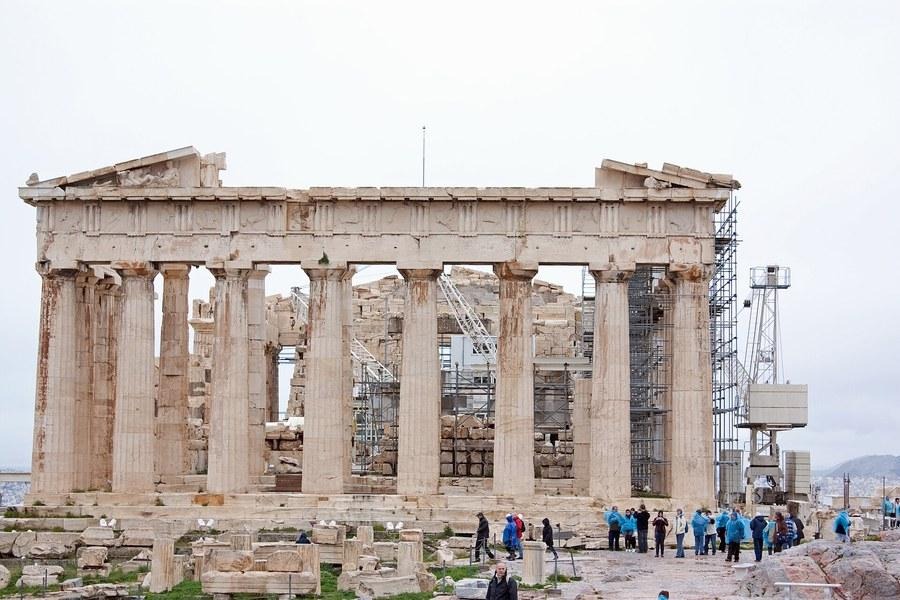
Book the first entry slot and be at the gate when it opens. A single adult ticket now costs €30, and the 50% winter reduction was scrapped on 1 April 2025, so November costs the same as August. Entry is timed to the hour, and the 8 am to 9 am slot is the largest of the day.
Work up through the Propylaea to the Parthenon, then the Erechtheion with its caryatid porch and the small Temple of Athena Nike. Come down the south slope past the Theatre of Dionysus and the Odeon of Herodes Atticus, both covered by the same ticket.
Practical tip: buy the timed ticket online before you fly, not at the gate. Slots for the first two hours sell out days ahead in summer, and those are the only hours with shade and bearable heat on the rock.
Afternoon (1:00 PM): Plaka and Anafiotika
Drop down into Plaka, the old quarter under the Acropolis, and climb the lanes to Anafiotika, a pocket of whitewashed island-style houses built by Cycladic stonemasons in the 19th century. It’s the closest thing to a Greek island you’ll find in central Athens.
Lunch at Ta Karamanlidika tou Fani on Sokratous, a delicatessen and ouzeri where you taste the charcuterie before you buy it. Then walk down to Hadrian’s Library and the Roman Agora, both a short stroll apart.
Evening (7:00 PM): Monastiraki and Souvlaki
Finish at Monastiraki Square, where the flea market streets fill in the evening and the Acropolis is floodlit above the rooftops. Bairaktaris on the square has been grilling since 1879 and is the easy first-night choice.
Order pork souvlaki wrapped in pita with tomato, onion, and a handful of chips inside, which is how Athens actually eats it. Overnight at Camping Athens in Peristeri, about 25 minutes from the center by metro and bus.
Day 2: Athens Museums and the Agora
Morning (9:00 AM): The Acropolis Museum
Start at the Acropolis Museum, ticketed separately from the hill at €20, with a glass floor over an excavated Athenian neighborhood and the Parthenon frieze laid out on the top floor at the same orientation as the temple itself. Allow two hours, more if the pieces hold you.
The top-floor gallery makes the gaps in the frieze visible, which is the clearest way to understand the argument over the sculptures held in London. The café terrace has the best free Acropolis view in the city.
Afternoon (1:00 PM): The Ancient Agora
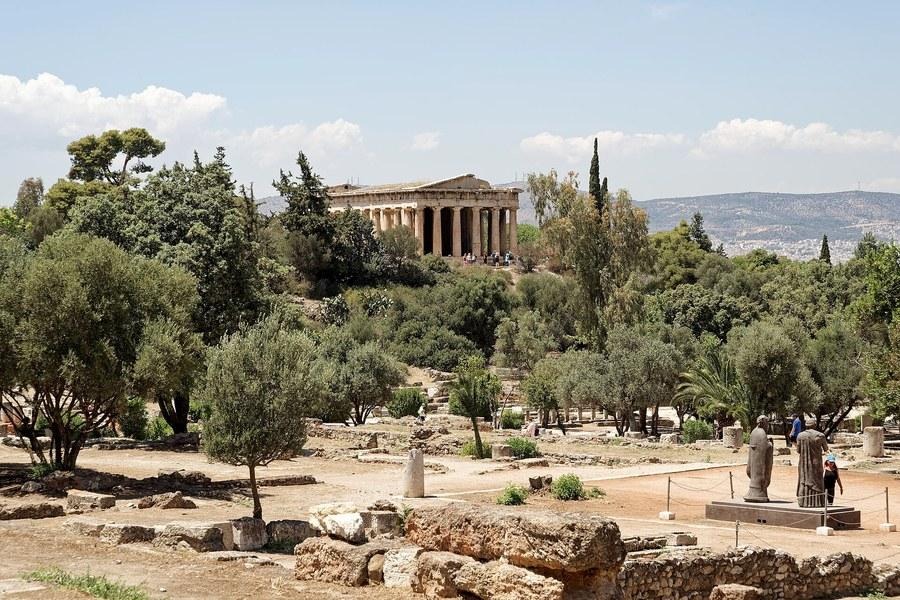
Walk north to the Ancient Agora, the civic heart of classical Athens, where Socrates argued and the assembly met. The Temple of Hephaestus here is the best-preserved Doric temple in Greece, better preserved than the Parthenon, and the reconstructed Stoa of Attalos houses the site museum.
Carry on to the Panathenaic Stadium, the marble horseshoe that hosted the first modern Olympics in 1896, then cut through the National Garden for shade.
Practical tip: the €30 combined ticket that once covered seven Athens sites for five days was discontinued in April 2025, so budget for individual entries and pick the two or three sites you actually want.
Evening (6:00 PM): Psyrri
Spend the evening in Psyrri, the workshop district turned into the city’s densest cluster of mezedopoleia and bars. Order a spread of small plates rather than a main, which is the local way and cheaper.
Finish with loukoumades, the honey-soaked dough balls sold from counters around Aiolou. Load the campervan with supermarket supplies tonight, because tomorrow you leave the city.
Day 3: The Athens Riviera and Cape Sounion
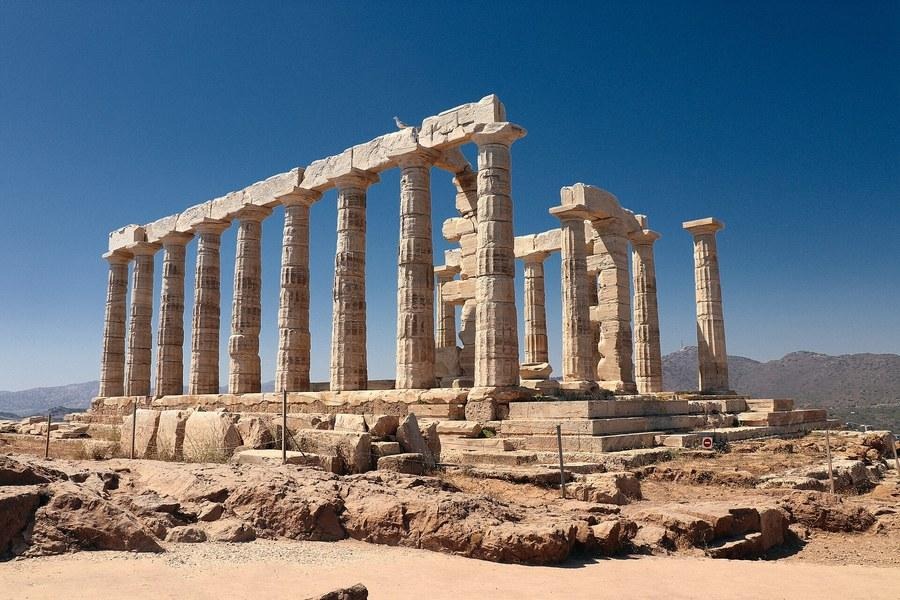
Morning (9:00 AM): Lake Vouliagmeni
Collect the campervan and head south down the coast road. Lake Vouliagmeni sits 25 km from central Athens, a geothermal lake fed by underground springs that holds around 24°C year-round, backed by a limestone cliff. An hour’s float here is the best possible start to the driving half of the trip.
The coast road on from Vouliagmeni traces the Athens Riviera through Varkiza and Lagonissi, a string of coves and beach clubs with easy parking at most access points.
Afternoon (1:00 PM): The Coast Road South
Take lunch at one of the fish tavernas along the Legrena waterfront near the tip of the peninsula, where the catch is chalked up daily and grilled octopus is the thing to order. This stretch is quiet compared with the Riviera closer to the city.
Cape Sounion sits 70 km from Athens, about an hour on the coast road, with a large paved car park at the site entrance that takes any vehicle size.
Practical tip: fill up at the station in Lavrio before the final stretch to Sounion. There’s no fuel at the cape itself, and Lavrio is the last reliable stop on the peninsula.
Evening (6:30 PM): The Temple of Poseidon
Time your entry for the last two hours of light. The Temple of Poseidon stands on a cliff 60 meters above the Aegean, and its surviving Doric columns catch the sunset directly. Entry is €20, in the same band as Delphi and Mycenae.
Byron carved his name into one of the columns in 1810, and you can still find it. Overnight at Camping Bacchus, 4.5 km from the temple, with 55 pitches and a quiet stretch of coast below.
Day 4: The Corinth Canal, Mycenae, and Nafplio
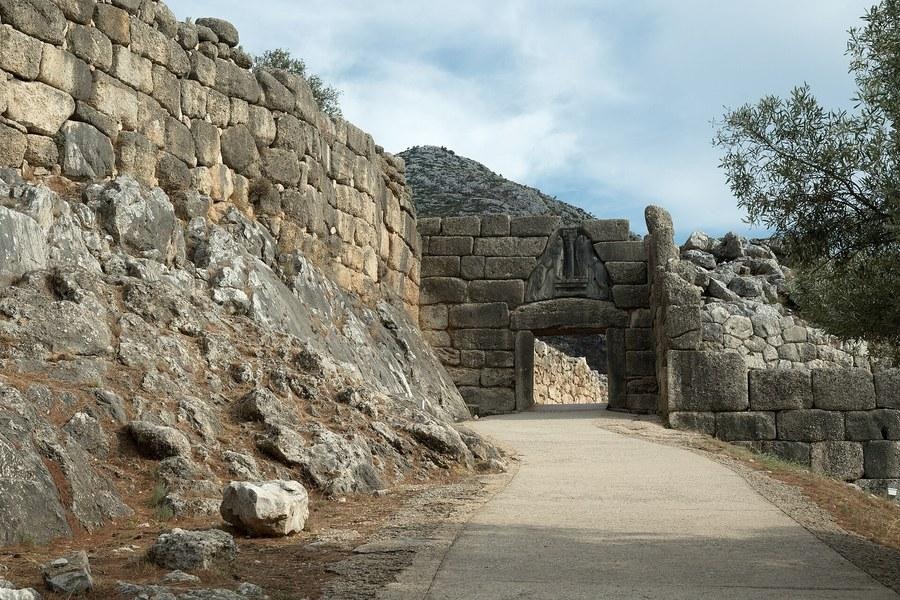
Morning (9:00 AM): The Corinth Canal and Ancient Corinth
Drive west around Attica to the Corinth Canal, 85 km from Sounion, a 6 km channel cut through solid rock in 1893 and barely wide enough for one ship. The pedestrian bridge over it is free and takes ten minutes, which is exactly the right amount of time.
Ancient Corinth sits 7 km south, with the archaic Temple of Apollo standing above the Roman forum and the fortress of Acrocorinth on the hill behind. Entry is €20 for the site and museum together.
Afternoon (1:00 PM): Mycenae
Carry on 50 km southwest to Mycenae, the Bronze Age citadel that gave its name to an entire civilisation. Walk in through the Lion Gate, the oldest monumental sculpture in Europe, then down into the beehive tomb known as the Treasury of Atreus, a corbelled dome 13 meters high built around 1250 BCE.
Mycenae keeps a combined site and museum ticket at €20, one of only four sites in Greece that still does, alongside Olympia, Delphi, and Aigai.
Practical tip: the ground inside the citadel is loose stone on a slope with no shade at all. Go in the last two hours before closing in summer, or first thing, and carry more water than you think you need.
Evening (6:00 PM): Nafplio
Drive the last 25 km to Nafplio, the Venetian-Ottoman port that served as Greece’s first capital after independence. The old town is marble-paved, bougainvillea-covered, and closed to most traffic, so park on the perimeter and walk in.
Dinner at Ta Fanaria on Bouboulinas Street, a family taverna running since 1980, where the moussaka and the oven-baked lamb are the orders. Overnight at Camping New Triton on Drepano beach, 12 km east.
Day 5: Nafplio and the Theater at Epidaurus
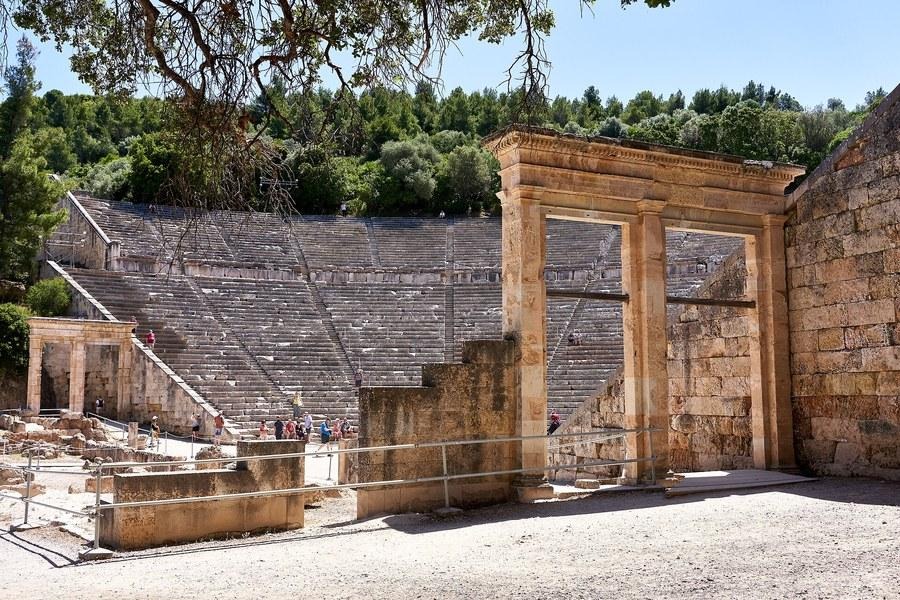
Morning (9:00 AM): Epidaurus
Epidaurus is 30 km east of Nafplio, and the theater is the reason to go early. Built in the 4th century BCE into a hillside, it seats 14,000 and has acoustics so exact that a coin dropped on the orchestra floor is audible in the back row. Test it yourself before the coaches arrive.
The wider sanctuary of Asklepios around it was an ancient healing center, with a stadium, guest quarters, and a museum of surgical instruments. Entry is €20 for site and museum.
Afternoon (1:00 PM): Palamidi Fortress
Back in Nafplio, climb the Palamidi fortress above the town, a Venetian bastion complex from 1714 reached by a staircase of around 900 steps, or by a road you can drive most of the way up. The view takes in the whole Argolic Gulf and the Bourtzi islet in the harbor.
Cool off afterwards at Arvanitia beach, a pebble cove on the far side of the headland reached by a seafront path from the old town.
Practical tip: drive the Palamidi access road rather than climbing the steps in summer. The staircase is fully exposed, and the road parking sits close to the upper gate.
Evening (7:00 PM): Nafplio’s Old Town
Spend the evening on Syntagma Square and the lanes off it, which fill with tables once the heat drops. This is the most pleasant town square on the whole route, and worth lingering in.
Stop at Antica Gelateria di Roma on Farmakopoulon for gelato made by a Roman family who settled here decades ago, then walk the seafront promenade under the fortress walls.
Day 6: Mystras and the Langada Pass
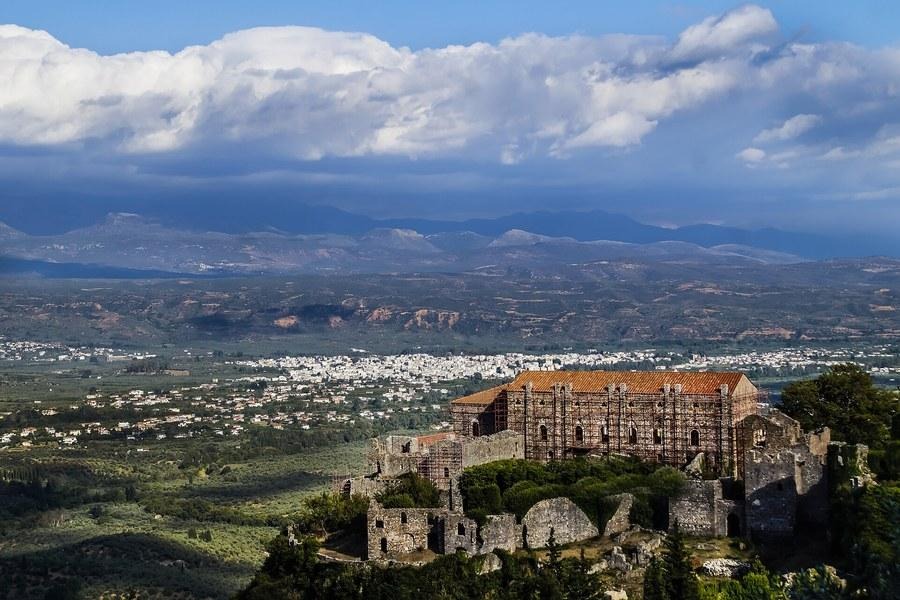
Morning (9:30 AM): South Through Arcadia
Leave Nafplio and drive southwest through Arcadia toward Laconia, about 145 km and 2 hours through mountain country that empties out fast once you clear Tripoli. This is the quietest driving of the fortnight and the first stretch that feels genuinely remote.
Stop in Tripoli or a roadside kafeneio for coffee. Fuel stations thin out south of here, so top up while you can.
Afternoon (1:00 PM): Mystras
Mystras is a Byzantine city built onto a spur of Mount Taygetos, abandoned in the 1830s and left almost intact. Frescoed churches, a palace complex, and a Frankish castle at the top climb the hillside in terraces, and the whole thing is a UNESCO World Heritage Site.
Enter at the upper gate and walk down rather than up, which saves a serious climb in the heat. Allow three hours, and expect to have whole chapels to yourself.
Practical tip: there are two entrances at different heights. Drive to the upper one, walk down through the site to the lower gate, then take the short road walk or a taxi back to the vehicle.
Evening (6:30 PM): Sparta and the Taygetos
Modern Sparta sits 6 km below in the valley, a grid-planned 19th-century town with almost nothing left of the ancient city, which is itself the point. Sparta built power, not monuments. The town’s grill houses do excellent Laconian sausage and local olive oil.
Overnight at Camping Castle View in Mystras, set among olive and mulberry trees under Mount Taygetos with the castle lit above.
Day 7: The Mani Peninsula and the Diros Caves
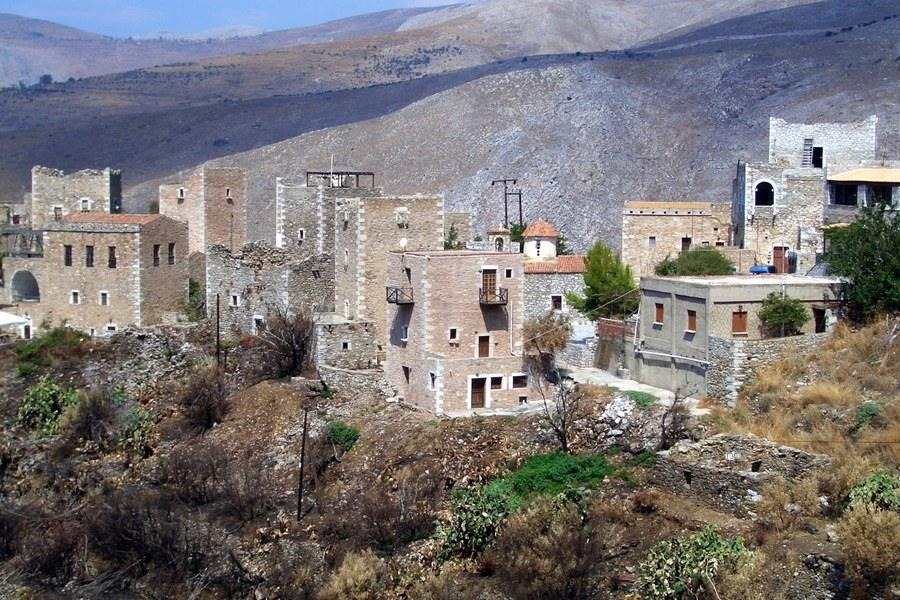
Morning (9:00 AM): Over the Langada Pass
Cross the Taygetos on the Langada Pass, a 59 km mountain road between Sparta and Kalamata that switchbacks through gorges and pine forest. It’s one of the best drives in Greece and takes about 90 minutes with stops.
Turn south at the coast for the Mani, the middle finger of the Peloponnese, a landscape of bare limestone, prickly pear, and stone tower houses built for feuding families.
Afternoon (1:00 PM): The Diros Caves
The Diros Caves near Pyrgos Dirou are toured by boat, poled through 1,200 meters of flooded chambers hung with stalactites, with a short walking section at the end. The standard ticket is around €12, and the temperature underground sits near 16°C, which makes it the best midday stop in the Mani.
Areopoli, 10 km north, is the Mani’s stone-built capital, with a main square where the Greek War of Independence was declared in 1821.
Practical tip: the Diros boat tours run on a queue system with no advance booking, and the wait can reach an hour in August. Arrive before 11 am or after 3 pm.
Evening (6:00 PM): Vathia and Cape Tainaron
Drive the last stretch south to Vathia, a hilltop cluster of abandoned tower houses that is the defining image of the Mani, then on toward Cape Tainaron, the southernmost point of mainland Greece and, to the ancients, an entrance to the underworld.
Turn back north to Stoupa for the night. Camping Mani there has olive-grove pitches, a taverna, and beach access, and the Messenian coast is a gentler landscape after the bare rock of the deep Mani.
Day 8: Kardamyli, Kalamata, and Ancient Messene
Morning (9:30 AM): Kardamyli
Kardamyli is a stone village on the Messenian Gulf where Patrick Leigh Fermor built the house that made this coast famous with British readers. The old quarter above the road, Palia Kardamyli, is a fortified cluster of towers and a 18th-century church.
Lunch at Lela’s Taverna by the harbor, opened in 1983 by Lela Giannakeas, who kept house for Leigh Fermor for years. The tables sit directly above the water.
Afternoon (1:30 PM): Kalamata
Kalamata is 35 km on, the region’s working city and the source of the olives. The central market on Wednesdays and Saturdays is the best food shop on the route, and the seafront runs several kilometers of tavernas.
Stock the campervan here with Kalamata olives, olive oil, local figs, and pasteli. Kardamo, opposite the railway station, is the town’s standout kitchen if you want one sit-down meal.
Practical tip: Kalamata is the last large supermarket before Olympia and the only easy LPG stop in the southern Peloponnese. Refill gas and water here rather than hoping for it in the hill villages.
Evening (5:00 PM): Ancient Messene
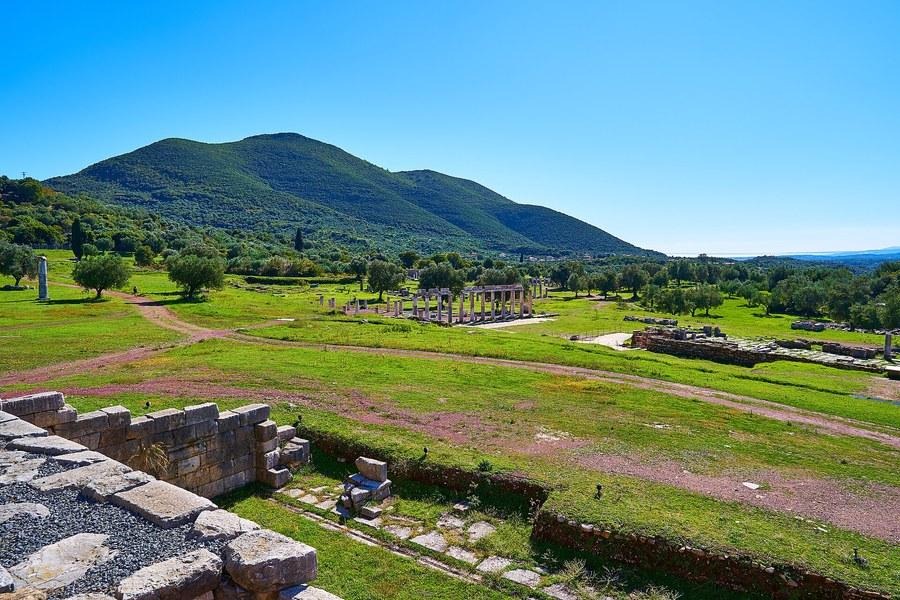
Ancient Messene, 30 km northwest near Mavrommati, is the sleeper of this itinerary. It’s one of the largest excavated city sites in Greece, with a stadium ringed by colonnades, a theater, a council house, and 9 km of city walls, and it gets a fraction of Mycenae’s visitors.
Because it’s a full city rather than a sanctuary, you walk streets and buildings rather than foundations. Overnight nearby or back on the Messenian coast, then push north in the morning.
Day 9: Ancient Olympia
Morning (8:30 AM): The Sanctuary
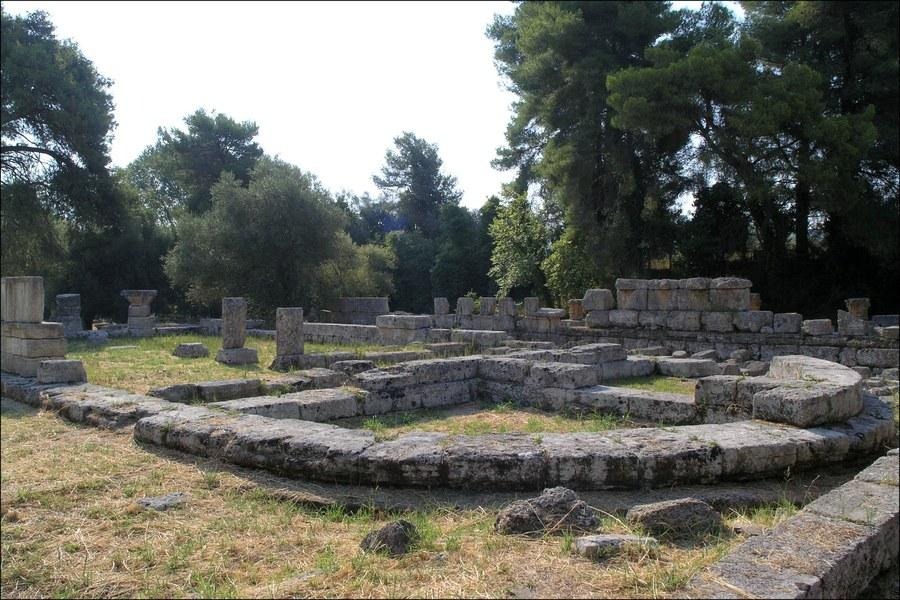
Olympia is roughly 140 km north through the Messenian and Elian hills, so leave early and arrive for opening. The sanctuary held the Games every four years for nearly 12 centuries, and the site runs along a wooded valley between two rivers, which makes it the shadiest of the major ruins.
Walk through the Temple of Zeus, which once held one of the Seven Wonders, then out through the vaulted tunnel into the stadium, where the running track is still marked by its original stone start and finish lines.
Afternoon (1:00 PM): The Archaeological Museum
The museum here is one of the best in Greece and is covered by the same €20 combined ticket. Its centerpiece is the Hermes of Praxiteles, alongside the pediment sculptures from the Temple of Zeus and the bronze helmet of Miltiades from the Battle of Marathon.
The separate Museum of the History of the Olympic Games in Antiquity is a short walk away and rarely busy.
Practical tip: the tunnel into the stadium is the one photograph everyone wants, and it’s empty for about 20 minutes after opening. That single detail is the clearest argument for camping beside a site instead of driving in from a city.
Evening (6:30 PM): Olympia Village
Modern Olympia is small, walkable, and geared to visitors, with a main street of tavernas and shops. Taverna Bacchus, just outside the village at Ancient Pisa, cooks over a hearth and looks out over olive groves.
Overnight at Camping Diana, 200 meters from the village center and 800 meters from the archaeological site, with a pool and pitches under pine cover.
Day 10: The Rio-Antirrio Bridge and Nafpaktos
Morning (9:30 AM): North to Patras
Drive north through Elis to Patras, about 110 km, then out to Rio for the crossing. This is an easy motorway morning after two days of hill roads, and a good one for laundry and restocking on the way through Patras.
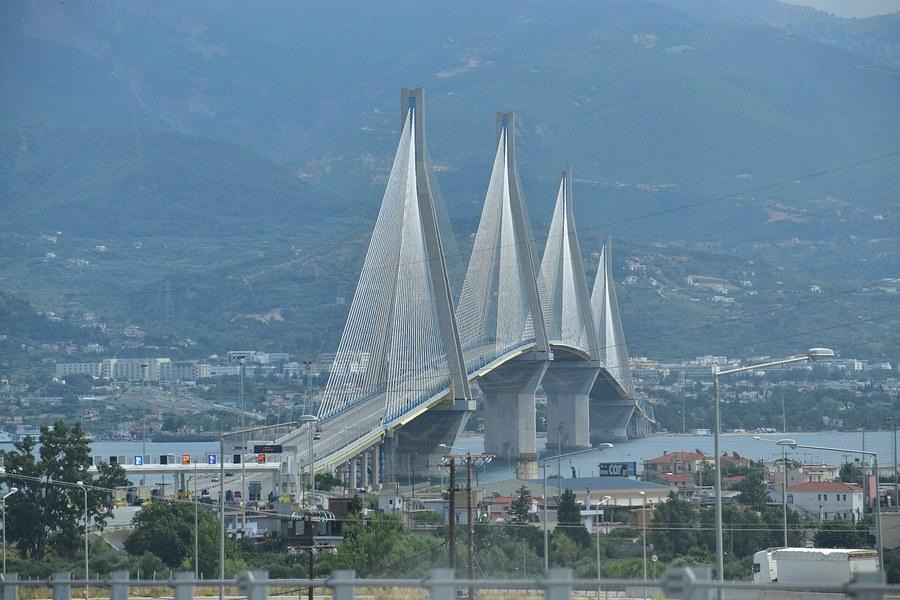
The Charilaos Trikoupis bridge at Rio is 2,880 meters of cable-stayed deck across the mouth of the Gulf of Corinth, one of the longest of its type anywhere.
Afternoon (1:00 PM): Crossing to Antirrio
The crossing takes five minutes and costs €15.90 for a passenger car, with campervans and taller vehicles in a higher class. The ferry that ran here before the bridge opened still operates alongside it, takes about 15 minutes, and costs less, so it’s worth comparing at the booth.
On the far side, Nafpaktos is 10 km east, a small town wrapped around a circular Venetian harbor with a castle climbing the hill behind it.
Practical tip: if you’re watching the budget, take the ferry rather than the bridge. It’s slower by ten minutes, cheaper for a large vehicle, and the view back at the bridge from the water is the better photograph anyway.
Evening (6:00 PM): Nafpaktos Harbor
The harbor at Nafpaktos is barely 50 meters across, ringed by stone walls and towers, with tavernas set into the arc of it. The naval battle of Lepanto was fought offshore here in 1571, and there’s a statue of Cervantes, who lost the use of his left hand in it, on the quay.
Eat fresh Gulf fish at one of the harbor tavernas and swim off the town beach beforehand. Overnight at Vrachos Beach Camping on the shore just east of town.
Day 11: Galaxidi and Delphi
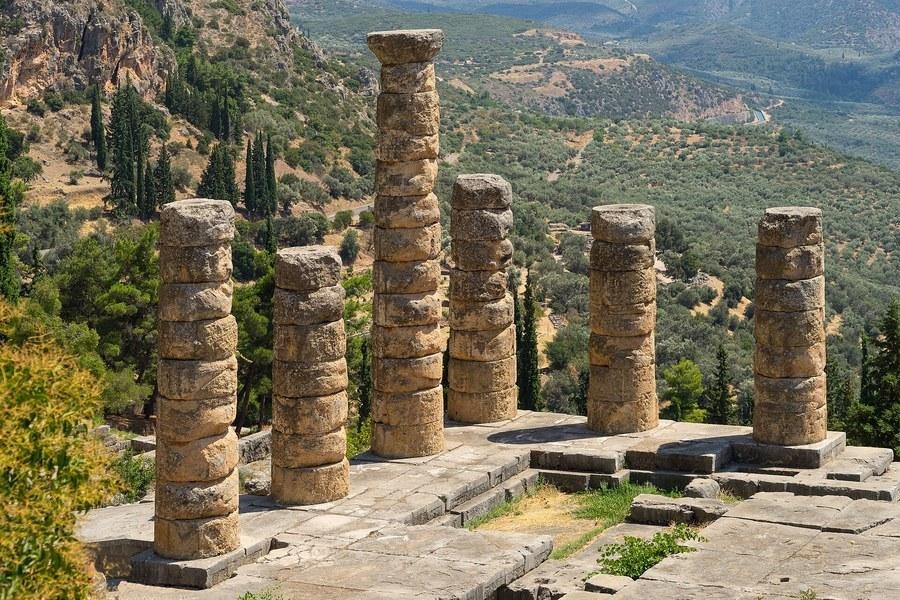
Morning (9:30 AM): The Gulf Road to Galaxidi
Follow the north shore of the Gulf of Corinth east, roughly 60 km of coast road with the Peloponnese mountains across the water. Galaxidi is a 19th-century shipping town of captains’ mansions and a working harbor, and it’s one of the prettiest stops on the route.
Have a mezze lunch at O Bebelis, which locals rate as the best table in town, then walk the pine-shaded headland path around the bay.
Afternoon (2:00 PM): Delphi
Delphi is 25 km inland and 550 meters up, on the slope of Mount Parnassus above a sea of olive trees. The ancients called it the navel of the world, and the Sacred Way climbs past treasuries to the Temple of Apollo, where the oracle delivered her famously ambiguous answers.
Entry is €20 for the site and museum together. Keep going up past the temple to the theater and the stadium, which most visitors skip and which hold the best views.
Practical tip: the approach road to Delphi is a mountain climb with switchbacks and narrow sections through the village. Park in the site car park rather than trying to stop on the village road, which has almost no room for a larger vehicle.
Evening (6:30 PM): The Museum and Dinner
The Delphi museum holds the Charioteer, a life-size bronze from 470 BCE with inlaid glass eyes and eyelashes still intact, and it’s worth the visit on its own. Give it an hour before closing.
Dinner at Taverna Vakhos on Apollonos, a family kitchen cooking what it grows, with a terrace over the valley to the Gulf. Overnight at Chrissa Camping, 5 km west of Delphi toward Itea.
Day 12: Arachova and the Drive to Meteora
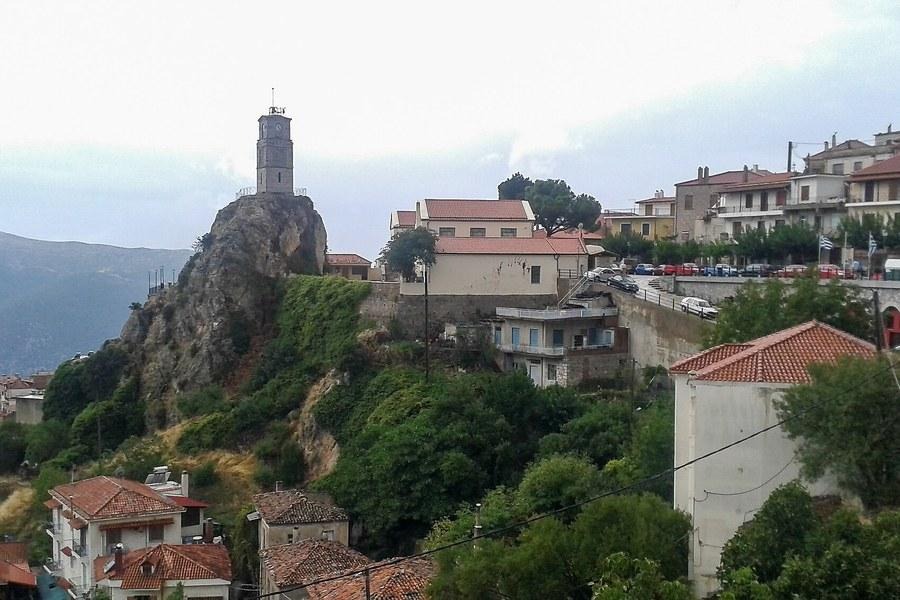
Morning (9:00 AM): Arachova
Arachova is 12 km east of Delphi, a stone mountain town stacked on the side of Parnassus, known for its weaving, its formaela cheese, and its winter ski crowd. In summer it’s calm and cool, and the clock tower steps give a view down the whole valley.
Buy formaela to fry in the van and a jar of Parnassus honey, then start north.
Afternoon (12:30 PM): Through Thessaly
The drive to Meteora is roughly 240 km and 3 hours, north through Livadeia and Lamia, then across the Thessalian plain, Greece’s agricultural heartland and a completely different landscape from anything so far. Flat, wide, and farmed, it makes the rock towers ahead more startling when they appear.
Break the drive at Thermopylae if you want the pass where 300 Spartans held the Persian army in 480 BCE, marked now by a monument beside the road.
Practical tip: the A1 north is tolled in segments, and the gates take cash or card. Keep €20 in coins and notes in the door pocket, since a card reader occasionally goes down at rural booths.
Evening (6:00 PM): First Sight of Meteora
Kalambaka sits directly under the rocks, and Kastraki, 2 km on, is the smaller and more pleasant village of the two. The sandstone pillars rise up to 400 meters straight out of the plain, with monasteries built on top of six of them.
Drive up to the Psaropetra or the sunset viewpoint above Kastraki for the first look, then eat at Taverna Panellinion on Kalambaka’s central square, running since 1950. Overnight at Camping Vrachos in Kastraki, at the foot of the rocks.
Day 13: The Meteora Monasteries
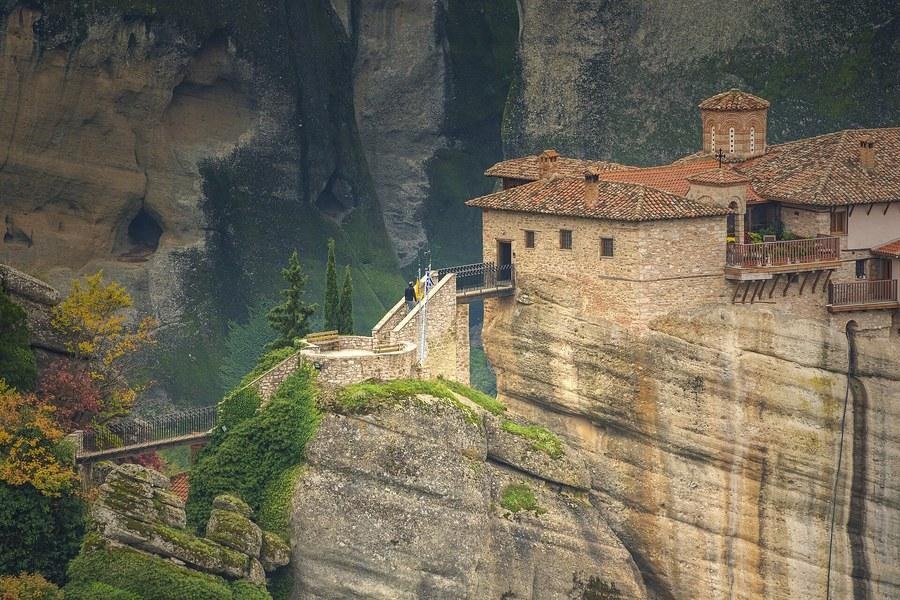
Morning (8:30 AM): Great Meteoron and Varlaam
Six monasteries are open to visitors, each charging €5 per monastery in cash at the door, and each closes on a different weekday. Great Meteoron, the largest and highest, closes Tuesdays. Varlaam, ten minutes’ walk away, closes Fridays.
Start at Great Meteoron at opening, climb the rock-cut stairway, and see the old kitchen, the ossuary, and the frescoed katholikon. Varlaam next, with its original rope-and-net winch tower still in place.
Practical tip: carry cash and check the closing days before you plan the route. All six are open on Saturdays and Sundays, but Sunday brings local worshippers and the biggest crowds, so Saturday is the better weekend day.
Afternoon (1:00 PM): Roussanou and Holy Trinity
Roussanou sits on a lower, narrower pillar reached by a small bridge and closes Wednesdays. It’s the most photographed of the six because the rock underneath is barely wider than the building.
Holy Trinity, which closes Thursdays, needs 140 steps cut into the rock and is the most dramatic approach. The dress code applies at all of them, with shoulders and knees covered and long skirts provided at the door.
Evening (6:30 PM): The Rock Trails
Between the monasteries run old footpaths that almost nobody uses, including a trail from Kastraki up to the ruins of the Ypapanti monastery. An hour on those paths at golden hour is the best of Meteora, and you’ll likely have it to yourself.
Eat in Kastraki tonight, where the village tavernas cook Thessalian pies and mushroom dishes from the surrounding hills.
Day 14: Meteora Back to Athens
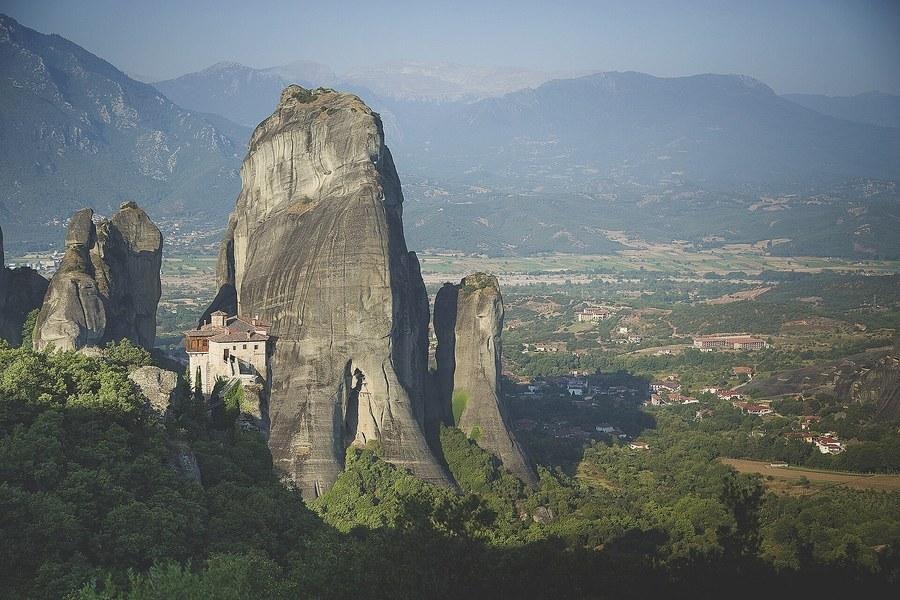
Morning (9:00 AM): A Last Look
Take one more drive on the monastery loop road before you go, which is 17 km of switchbacks between the pillars and takes 40 minutes without stopping. Morning light hits the eastern rock faces and is better than the evening for photographs from the road.
Then point the vehicle south on the A1 for the run back to Athens, roughly 360 km and 4 hours.
Afternoon (1:00 PM): The Road South
The drive is straightforward motorway through Thessaly and Boeotia, with service stations at reasonable intervals. Stop at Thermopylae if you skipped it on the way up, or at Kamena Vourla for a swim on the Evian Gulf.
Plan to reach the depot in the early evening with time to empty tanks and refuel. Athens traffic is heaviest between 3 pm and 6 pm on the approach from the north.
Practical tip: refuel within 20 km of the drop-off rather than in Athens itself, where forecourts are tight for a larger vehicle. The stations on the National Road just north of the city are the easiest last stop.
Evening (7:00 PM): One Last Athens Meal
Drop the campervan, then take the metro back into the center for a final dinner. After 14 days of ruins, the view of the floodlit Acropolis from a Psyrri or Koukaki rooftop lands differently than it did on Day 1.
Order bougatsa for breakfast tomorrow from a counter near Monastiraki, and finish where the trip started, under the rock.
That completes the loop back to where it started, and an RV rental in Athens is what makes the return leg a drive rather than a scramble for a one-way flight.
Alternative Greece Itineraries
The route above balances two Athens days with a 12-day mainland loop. Here are two ways to reshape a Greece 2-week itinerary depending on what you want out of it.
14-Day Northern Greece and Zagori Route
- Days 1 to 3: Athens and Cape Sounion as above, then north rather than south.
- Days 4 to 5: Delphi and Arachova, with a night on the Gulf at Galaxidi.
- Days 6 to 7: Meteora, the monasteries, and the rock trails from Kastraki.
- Days 8 to 10: the Zagori villages and the Vikos Gorge, one of the deepest gorges in the world relative to its width, with stone arched bridges and free hiking. A campervan rental in Greece is the only practical way to reach these villages, since bus service is sparse.
- Days 11 to 12: Ioannina on its lake, then south down the Ionian coast to Parga and Preveza.
- Days 13 to 14: the Ionian Road south to Rio, across the bridge, and back to Athens through the northern Peloponnese.
14-Day Mainland and Islands Combination
- Days 1 to 9: pick up the campervan and run the Peloponnese half of the main route, from Athens through Corinth, Mycenae, Nafplio, Mystras, the Mani, and Olympia.
- Day 10: return the vehicle to the Athens depot and switch to foot-passenger travel.
- Days 11 to 14: take a high-speed ferry from Piraeus to the Cyclades, basing on one island rather than three to avoid spending the leg in ports.
Note the trade-off before you commit. Cruise passengers landing at Santorini or Mykonos now pay a €20 levy in peak season, which reflects how hard those two islands are working to manage numbers. A quieter island such as Naxos or Sifnos gives you more for four days, and you keep the campervan half of the trip intact.
Map of Your 14-Day Greece Itinerary
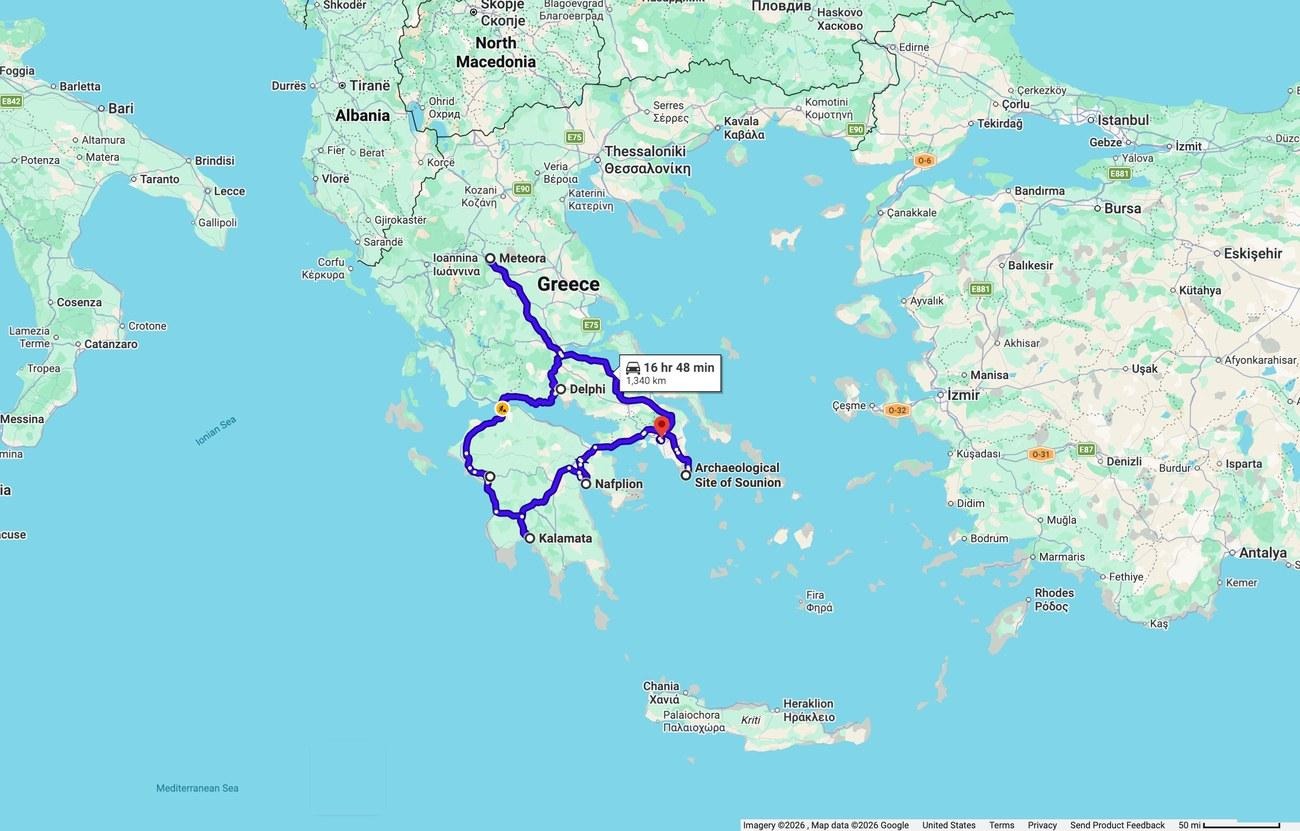
The route runs as a single anticlockwise loop out of Athens and back. South to Cape Sounion, west across the Corinth Canal to Mycenae and Nafplio, south again through Mystras to the Mani, north up the Messenian coast to Olympia, across the Rio-Antirrio bridge to Nafpaktos, east along the Gulf to Delphi, north to Meteora, then the A1 straight back to Athens.
Total driving comes to roughly 1,660 km (1,030 miles) across two weeks, an average of about 120 km a day, with only two stretches over 240 km. Budget €120 to €180 for motorway and bridge tolls across the full loop.
Budgeting for Your Trip: How Much Does 14 Days in Greece Cost?
Greece sits in the middle of the western European cost range, with two features that shape the maths on this route. Food is noticeably cheaper than northern Europe once you leave the most touristed streets, and motorway tolls are a real line item rather than a rounding error.
The campervan is the biggest lever. It replaces 13 hotel nights with campsite pitches at €18 to €35, and it gives you a kitchen, which matters when a supermarket dinner costs a fifth of a taverna one. Here’s a realistic per-person breakdown, not counting the vehicle hire itself.
| Category | Budget | Mid-Range | High-End |
| Accommodation | €10 to €15/night | €15 to €22/night | N/A (hotels) |
| Food & Drink | €18 to €28/day | €35 to €55/day | €80+/day |
| Attractions | €8 to €15/day | €15 to €25/day | €35+/day |
| Fuel & Tolls | €12 to €18/day | €18 to €26/day | €30+/day |
| Daily Total | €48 to €76 | €83 to €128 | €175+ |
| 14-Day Total | ~€670 to €1,065 | ~€1,160 to €1,790 | ~€2,450+ |
Budget traveler: cook most meals from Greek supermarkets such as Sklavenitis, AB Vasilopoulos, and Lidl, choose the standard pitch over the sea-view one, and be selective about entries. Skipping two of the €20 sites saves more than a night’s camping. Around €900 per person for the fortnight is realistic.
Mid-range traveler: eat lunch out and cook dinner, pay for every major site including the Acropolis at €30 and the museum at €20, and take the Diros boat tour. Budget €1,100 to €1,800 per person.
High-end traveler: eat out twice a day, add seafood dinners in Nafplio and Galaxidi, book premium coastal pitches, and take a guided tour at Mycenae and Delphi. Expect €2,500 or more per person.
Two Greek specifics are worth planning for. Diesel ran around €1.95 a litre in mid-2026, and a campervan burning 20 to 25 litres per 100 km over 1,660 km puts fuel near €650 to €810 for the vehicle across the fortnight. Tolls add another €120 to €180 on top, most of it on the A1 and the Rio-Antirrio crossing.
Plan Your Greece Road Trip with Indie Campers
Two weeks on the Greek mainland puts you at a dozen major sites, and the difference between a good trip and a crowded one is what time you walk through each gate. Hotels in Nafplio and Kalambaka are limited and price up sharply from June, which pushes most visitors into long day trips from Athens and into the 11 am coach crush.
A campervan from Indie Campers fixes both. You sleep beside the site and arrive at opening, and company-owned vehicles come with unlimited mileage, which matters on a 1,660 km loop where a per-kilometer cap would turn a detour to Ancient Messene into a bill.
Booking early costs you nothing. Cancel free up to 31 days before pick-up and pay in full only 30 days out, so you can hold September dates before the campsites fill.
Book your campervan and kickstart an adventurous Greece trip now!
Greece Itinerary 14 Days: Your Final Planning Recap
| Category | Details |
| Best Time to Go | Late April to early June, or September to mid-October, for warm days, open campsites, and walkable sites. |
| Recommended Budget | €1,100 to €1,800 per person for 14 days, plus campervan hire. |
| Days in Athens | 2 days for the Acropolis, the museum, the Agora, and Plaka, done on foot and by metro. |
| Main Regions | Attica, the Argolid, Laconia and the Mani, Messenia, Elis, Phocis, and Thessaly. |
| Best Restaurants | Ta Karamanlidika tou Fani in Athens, Ta Fanaria in Nafplio, Lela’s Taverna in Kardamyli, O Bebelis in Galaxidi, Taverna Vakhos in Delphi. |
| Recommended Transport | Campervan rental, which combines accommodation and transport and comes with unlimited mileage. |
| Total Driving | Approx. 1,660 km (1,030 miles), averaging 120 km a day. Tolls €120 to €180 for the loop. |
| Must-See Sights | The Acropolis, Mycenae, Epidaurus, Mystras, the Diros Caves, Olympia, Delphi, Meteora. |
| Accommodation | Licensed campsites at €18 to €35 per pitch per night. Wild camping is prohibited. |
| Perfect For | History travelers, couples, families, and anyone who wants ancient sites without the coach crowds. |
Frequently Asked Questions (FAQs)
How many days do you need in Greece?
You need 14 days to cover the Greek mainland properly, which is what this Greece itinerary 14 days plan is built around. Seven days cover Athens and the Peloponnese as a tight loop, and 10 days adds Delphi. Two weeks is what lets you reach Meteora as well without a single 400 km driving day. For the islands on top of the mainland, plan 18 days or more.
Is 14 days enough to see Greece?
Fourteen days is enough to see the Greek mainland in depth or to see four or five islands, but not both. This 2-week Greece itinerary covers roughly 1,660 km through Athens, the Peloponnese, Delphi, and Meteora, which is six of the country’s most significant ancient sites. Trying to add a Cycladic island run to that means spending three of your 14 days in ports and airports.
Can I take a campervan to the Greek islands?
Taking a rental campervan to the Greek islands is impractical for most travelers, because ferry rules on vehicle size, crossing cost, and summer capacity work against large vehicles. Plan a mainland route instead and treat the islands as a separate trip by plane or foot-passenger ferry. Indie Campers runs one Greek depot, in Athens, which is set up for mainland loops rather than island crossings.
Is wild camping legal in Greece?
Wild camping isn’t legal in Greece. Greece’s 2025 camping law prohibits setting up tents and parking camper vehicles at archaeological sites, coastal areas, beaches, and public places, with fines of €300 per person or vehicle. Even where parking is allowed, you can’t spread awnings or furniture beyond the vehicle’s own footprint. Book a licensed campsite instead, at €18 to €35 per pitch on this route.
How much does 2 weeks in Greece cost?
Two weeks in Greece on a campervan trip costs roughly €900 per person for budget travelers, €1,100 to €1,800 for mid-range, and €2,500 or more for high-end, not counting the vehicle hire. Campsite pitches run €18 to €35 a night against hotel rates that climb sharply in Nafplio and Kalambaka from June. Fuel for the 1,660 km loop lands near €650 to €810, with tolls adding €120 to €180.
How much is a ticket to the Acropolis in 2026?
An adult ticket to the Acropolis costs €30, and the Acropolis Museum is ticketed separately at €20, so the pair costs €50. Greece’s April 2025 pricing reform abolished the old winter discount, so the price is the same year-round, and the combined ticket that once covered seven Athens sites was discontinued at the same time. Entry is timed to the hour and should be booked online.
What are the best day trips from Athens by campervan?
The best day trips from Athens are Cape Sounion for the Temple of Poseidon (70 km, 1 hour on the coast road), the Corinth Canal and Ancient Corinth (85 km, 1 hour), and Marathon with its battle tumulus (42 km, 45 minutes). Delphi is 180 km and works better as an overnight than a day trip. All of them are straightforward drives on well-surfaced roads with parking that takes a larger vehicle.
Do I need a visa to visit Greece?
Visitors from the US, Canada, Australia, the UK, and most other non-EU countries don’t need a visa for tourist stays in Greece of up to 90 days in any 180-day period. The EU’s ETIAS travel authorization has been delayed repeatedly and is now expected to carry a €20 fee, so check the official EU guidance for your nationality before you book. Non-EU drivers should also carry an International Driving Permit alongside their home licence.
When is the best time to visit Greece?
The best time to visit Greece for this route is late April to early June or September to mid-October, when days sit between 18 and 27°C and the archaeological sites are walkable in comfort. September holds the warmest sea of the shoulder months. July and August pass 35°C in the Peloponnese interior and around Meteora, which turns unshaded sites such as Mycenae into hard work, and winter shortens the monastery hours to roughly 09:00 to 14:00.