Key Takeaways
Planning a Spain itinerary 10 days long? This guide covers 3 of Spain’s most iconic regions (including Catalonia, Andalusia and central Castle), with enough time to actually enjoy each of them to the fullest.
Here’s what to expect:
- Iconic Stops: Barcelona’s Sagrada Família, Seville’s Royal Alcázar, and Madrid’s Prado Museum.
- Hidden Gems: The whitewashed hilltop town of Ronda and the Mezquita-Catedral in Córdoba.
- Recommended Transport: Renting an RV with Indie Campers is the most flexible way to travel between cities and countryside on your own schedule, with accommodation included.
- Recommended Budget: Plan for a budget around €80-€150 per person per day, covering campsites, food, fuel, and major attractions (excluding RV rentals).
- Best Time to Go: Spring (April-June) or Autumn (September-October); warm weather, fewer crowds, and pleasant temperatures for exploring both cities and countryside.
Spain Itinerary 10 Days: At a Glance
| Day | Location(s) | Top Highlights |
| Day 1 | Barcelona | Gothic Quarter, La Rambla, Barcelona Cathedral. Try pan con tomate. |
| Day 2 | Barcelona | Sagrada Família, Casa Batlló, Park Güell. Try patatas bravas at a local bar. |
| Day 3 | Montserrat & Barcelona | Montserrat monastery hike, Barceloneta beach sunset. Try seafood paella. |
| Day 4 | Zaragoza | Basílica del Pilar, Mudéjar towers, Aljafería Palace. Try ternasco lamb. |
| Day 5 | Madrid | Arrival, Puerta del Sol, Plaza Mayor, Mercado de San Miguel. Try bocadillo de calamares. |
| Day 6 | Madrid | Royal Palace, El Retiro Park, Prado Museum. Try cocido madrileño. |
| Day 7 | Toledo & Córdoba | Toledo cathedral and old city, Mezquita-Catedral in Córdoba. Try salmorejo. |
| Day 8 | Seville | Royal Alcázar, Seville Cathedral, Plaza de España. Try espinacas con garbanzos. |
| Day 9 | Ronda & White Villages | Puente Nuevo Bridge, Pueblos Blancos drive. Try oxtail stew (rabo de toro). |
| Day 10 | Granada | Alhambra palace, Albaicín quarter, flamenco show. Try tortilla sacromonte. |
Table of Contents
- Spain Itinerary 10 Days: At a Glance
- Why You’ll Love a 10-Day Trip to Spain
- Best Time to Visit Spain
- Are 10 Days Enough to Visit Spain?
- How to Get Around Spain
- The Ultimate Spain Itinerary: 10 Days of Adventure
- Exploring Spain’s Regions: Alternative Itineraries
- Map of Your 10-Day Spain Itinerary
- Budgeting for Your Trip: How Much Does 10 Days in Spain Cost?
- Plan Your Spain Road Trip with Indie Campers
- 10-Day Spain Itinerary: Your Final Planning Recap
- FAQs About Spain Itinerary 10 Days
Why You’ll Love a 10-Day Trip to Spain?
Planning a 10 day Spain itinerary gives you something rare in European travel: enough time to see the big cities, detour into the countryside, and still arrive at each destination without feeling rushed.
Spain is one of the most diverse countries in Europe, and that diversity is the whole point. In 10 days you can stand under Gaudí’s ceiling at the Sagrada Família, walk through Moorish palaces in Andalusia, eat your way through Madrid’s food markets, hike above a monastery perched on a mountain, and watch a proper flamenco show in a candlelit Seville theatre.
The North and South feel like different countries entirely: the architecture changes, the food changes, the pace changes. That contrast is what makes a Spain itinerary 10 days long genuinely worthwhile rather than repetitive.
A campervan makes this route work in a way trains and buses simply can’t.
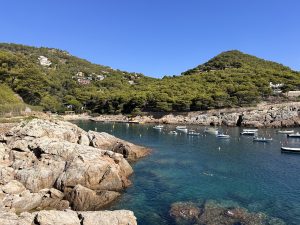
The Renfe high-speed train connects Barcelona, Madrid, and Seville efficiently; but it drops you in city centers and charges extra luggage fees, and the countryside between those cities, where some of the best experiences live, is completely inaccessible. With a campervan, you stop when you want. You pull over for the whitewashed village on the hill that isn’t in the guidebook. You camp above the Costa Brava at sunset and wake up with views that a hotel lobby will never give you.
Indie Campers has pickup locations across Spain – including Barcelona, Madrid, Seville, Malaga, and Valencia; making a one-way route from north to south completely straightforward.
The food is the third reason to take this trip seriously.
Every region you pass through on this 10 day Spain itinerary has its own culinary identity:
- Catalonia gives you pan con tomate and seafood.
- Madrid offers cocido madrileño and bocadillo de calamares
- Andalusia brings Salmorejo, espinacas con garbanzos, and rabo de toro.
Spain receives more Michelin stars per capita than almost any other country, and you don’t need a reservation at a starred restaurant to eat exceptionally well, since a good tapas bar and a glass of local wine will do the same job for a fraction of the price.
Say what you may, but the truth is: Spain doesn’t disappoint and this 10-day Spain itinerary is designed to show you exactly why.
Best Time to Visit Spain
The season you visit shapes everything when planning a 10-day Spain itinerary; from the crowds at the Alhambra to the heat on a midday city walk.
Here’s a quick view of what things are like, across each season:
Spring (April to June)
Spring is the best time to visit Spain for most travelers. The temperatures are warm enough for outdoor exploration without the aggressive summer heat that can make city sightseeing exhausting.
The countryside is green, wildflowers bloom across Andalusia, and the orange blossom season in Seville fills the air with a scent unlike anything else in Europe. Crowds are manageable at major attractions, and prices are noticeably lower than in July and August.
- Average Temperatures: 59-77°F (15-25°C) in the south; 55-70°F (13-21°C) in the north
- What to expect: Warm, pleasant weather ideal for both city walking and countryside driving. Moderate crowds and mid-range prices. Book the Alhambra and Sagrada Família tickets weeks in advance regardless of season.
Summer (July to August)
Summer is Spain’s peak tourist season, and it comes with a trade-off. The days are long, the beaches are at their best, and festivals happen everywhere – but Seville and Madrid can hit 104°F (40°C) in July, which makes afternoon city walking genuinely uncomfortable. Barcelona remains more temperate, but crowds at Gaudí sites reach their highest levels of the year.
- Average Temperatures: 86-104°F (30-40°C) in Andalusia and central Spain; 77-86°F (25-30°C) in Barcelona
- What to expect: Intense heat in the south and center, peak crowds nationwide, the highest prices of the year. Book everything months in advance and plan outdoor sightseeing for early morning or evening.
Autumn (September to October)
Autumn is the overlooked gem of Spanish travel. The summer crowds have thinned, the temperatures drop to something more comfortable, and the coastal areas are still warm enough for a swim through September. The wine harvest season (vendimia) brings festivals to La Rioja, Ribera del Duero, and Penedès – while the vineyards turn gold and amber through October.
- Average Temperatures: 64-82°F (18-28°C) in the south; 59-73°F (15-23°C) in the north
- What to expect: Comfortable temperatures for sightseeing, noticeably fewer crowds than summer, lower prices, and the wine harvest season adding a cultural dimension to any route through Spain’s wine regions.
Winter (November to February)
Winter in Spain depends heavily on where you are. Andalusia and the Mediterranean coast remain mild; Seville and Málaga in December are perfectly pleasant for city walks and outdoor dining. Madrid and Barcelona turn cold, and the mountains see snow. The Canary Islands and southern coast attract visitors escaping colder European climates, so those areas remain busy.
- Average Temperatures: 46-59°F (8-15°C) in central Spain; 55-64°F (13-18°C) in Andalusia
- What to expect: Cold to mild temperatures depending on region, the fewest crowds at major sites, the lowest prices of the year, and a festive atmosphere through December with Christmas markets in most cities.
Are 10 Days Enough to Visit Spain?
Yes, a Spain itinerary 10 days long is good enough to experience the magic of Spain, provided the route you take is planned around a focused geographic path – rather than trying to cover every region.
Spain is a big country – roughly 1,000km from Barcelona in the northeast to Cádiz in the southwest. The mistake most people make is trying to add too many cities, which means spending a significant portion of each day in transit rather than actually experiencing a place.
Our 10 day Spain itinerary follows a deliberate north-to-south route: Barcelona to Madrid to Andalusia. That path covers the country’s three most visited and culturally distinct regions without unnecessary backtracking.
During this time, you’ll see Gaudí’s architecture in Catalonia, the royal heart of Madrid, Moorish palaces and flamenco in Andalusia, and the dramatic landscapes of Ronda and Granada.
You won’t cover the Basque Country, Galicia, or Valencia on this route – but will leave with a thorough and genuinely varied picture of what Spain is, and a list of reasons to come back.
How to Get Around Spain?
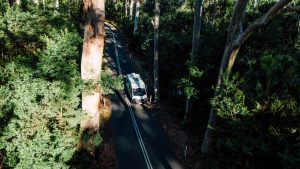
A campervan is the best, and most flexible way to complete your 10-day Spain itinerary, plus it’s more practical than it might initially seem. Spain’s AVE high-speed train network is great between major cities, but it only makes sense if you’re hopping between Barcelona, Madrid and Seville and sticking to city centres.
The moment you want to visit Ronda, stop at a vineyard in La Rioja, poke around a white village in Cádiz province, or reach a campsite above the Mediterranean – the train stops being useful.
Renting a car might solve the problem a bit, but then you’re paying for a hotel at every stop. Availing an RV rental in Spain rolls transport and accommodation into one daily cost, a combination that works extremely well.
Moreover, Spain also has one of the best campsite networks in Europe. You’ve got everything from well-equipped autocaravana parks near city centers to wilder spots along the Costa Verde coast and in the Andalusian mountains.
Freedom camping is permitted in designated areas too. With a campervan, you wake up where you parked, move when you’re ready, and skip the whole hotel booking juggle that comes with a fixed itinerary.
Indie Campers is present across multiple Spanish cities including: Barcelona, Madrid, Seville, Malaga, Valencia and others. In this scenario, a one-way rental with pick up in Barcelona and drop-off at Malaga or Seville is pretty straightforward.
Plus, all our vehicles come with unlimited mileage, so driving the extra distance to Ronda or the White Villages won’t cost extra. The fleet goes from compact two-berth vans to larger family motorhomes, and everything from booking to 24/7 support is handled online.
The Ultimate Spain Itinerary: 10 Days of Adventure
Are you ready for an epic road trip experience? 10 days, 3 regions and more food than you can reasonably devour.
This is a detailed, 10-day Spain itinerary that’ll ensure you make the most of your Spanish adventure:
Day 1: Arrive in Barcelona
Morning (10:00 AM): Gothic Quarter & La Rambla
Most international flights into Spain arrive in Barcelona, making it the natural starting point for this Spain itinerary 10 days guide. After picking up your campervan from the Indie Campers depot, head into the city and park near the Gothic Quarter; the Zona Franca campsite is a practical base just outside the center with good metro connections.
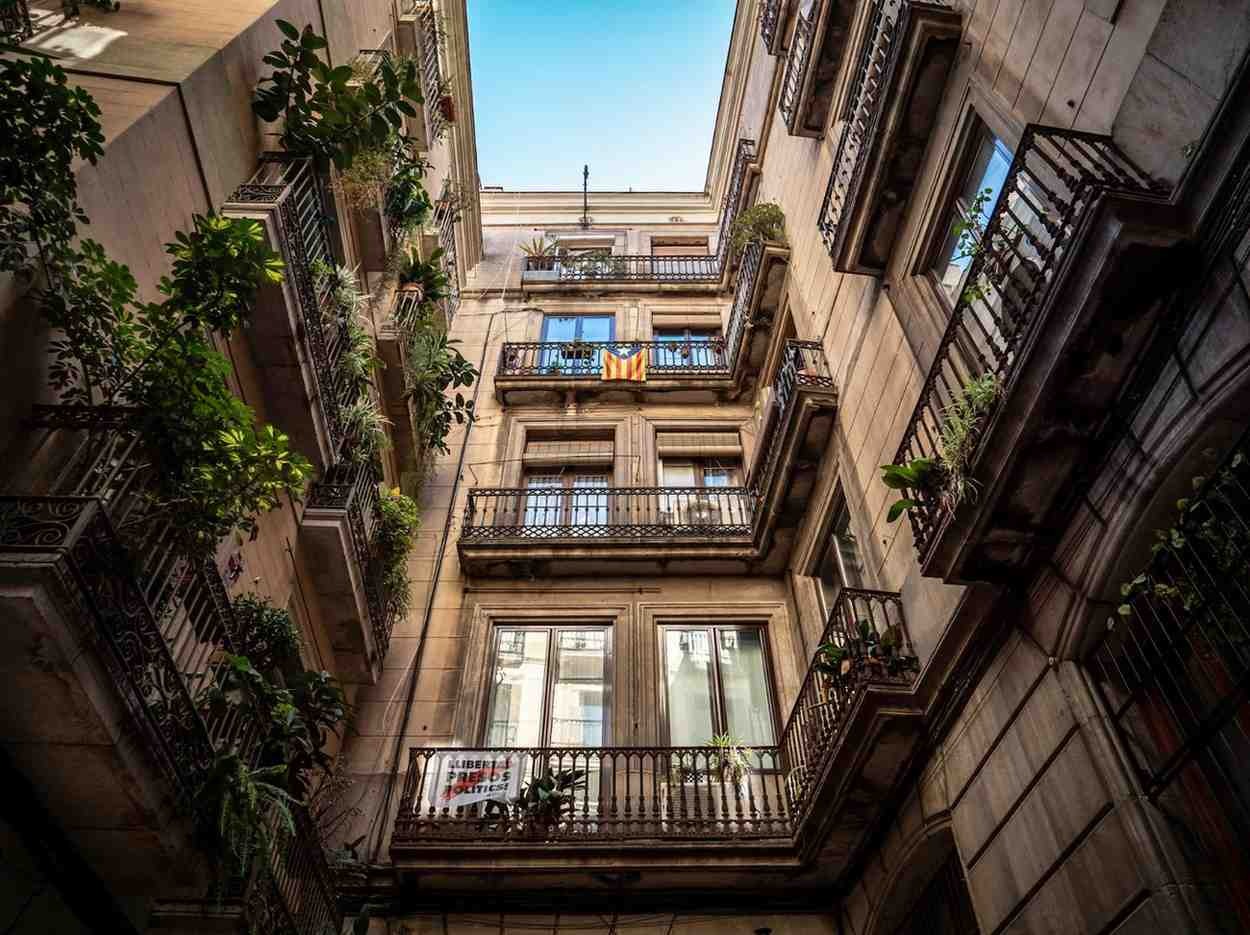
The Gothic Quarter (Barri Gòtic) is where Barcelona’s 2,000-year history is most visible. The narrow medieval lanes, Roman walls, and the soaring Barcelona Cathedral (free before 12:30 PM, €9 after) make for an atmospheric morning walk. The cathedral’s rooftop offers views over the old city that are worth the separate €3 fee.
From the Gothic Quarter, walk to La Rambla: Barcelona’s famous pedestrian boulevard running from Plaça de Catalunya to the waterfront. It’s touristy, but the Boqueria Market just off La Rambla is genuinely excellent for breakfast: fresh fruit, Spanish cheese, jamón ibérico, and a coffee at one of the market bars.
Practical tip: Visit the Boqueria before 10:00 AM. After that, the tourist crowds make it difficult to navigate and the prices at market bars double.
Afternoon (1:30 PM): El Born & the Waterfront
After the Gothic Quarter, walk east to the El Born neighbourhood, a slightly hipper, less crowded version of the Gothic Quarter with good independent restaurants, the Basílica de Santa Maria del Mar, and the Picasso Museum (€12, book ahead online).
For lunch, find a spot in El Born and order pan con tomate – Catalonia’s foundational snack of bread rubbed with tomato and drizzled with olive oil. It’s served everywhere and it’s better than it sounds. El Xampanyet on Carrer de Montcada is a classic option with excellent house cava and simple tapas.
After lunch, walk down to the Barceloneta waterfront to get a first look at the Mediterranean. The beach is busy but the port area, with its fishing boats and seafood restaurants, gives you a better sense of the city’s relationship with the sea.
Evening (7:00 PM): Plaça Reial & Dinner
As evening arrives, make your way back to Plaça Reial, a grand 19th-century square just off La Rambla with palm trees, colonnaded buildings, and a dozen restaurants and bars around its perimeter. The square comes alive at dusk and is one of the more atmospheric spots in the city for an aperitivo hour.
For dinner, stay in the Gothic Quarter or head back to El Born. Barcelona’s evening starts late, restaurants fill up from 9:00 PM and tapas bars are at their best between 8:00 PM and midnight. Order a tabla de embutidos (a board of cured meats) and a bottle of Priorat or Penedès red wine. The day ends with the salt air of the Mediterranean drifting through the backstreets of one of Europe’s great cities.
Day 2: Gaudí, Tapas & Park Güell
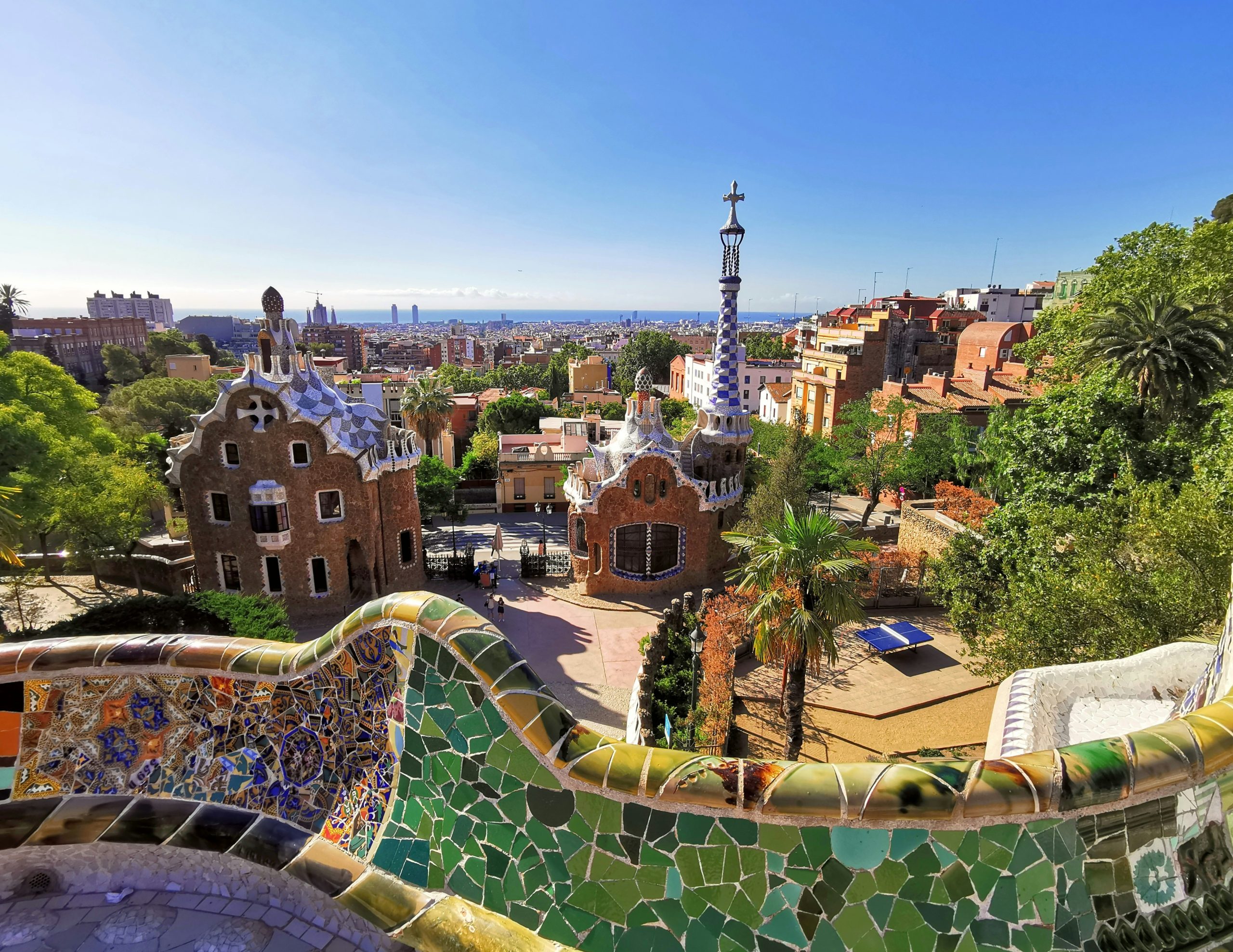
Morning (9:00 AM): Sagrada Família
Today is built around Antoni Gaudí, the Catalan architect whose work defines Barcelona’s visual identity more than anything else.
Start at the Sagrada Família, Gaudí’s still-unfinished basilica and the most visited building in Spain. Construction began in 1882 and continues today; the combination of Gothic structure and Art Nouveau ornamentation produces a building that looks like nothing else on earth. The interior, flooded with colored light from stained glass windows on both sides, is even more extraordinary than the exterior.
Book tickets well in advance – at least two weeks ahead in spring and summer, more during peak season. Adult tickets with tower access are €36. Allow at least 90 minutes inside. Arrive at your booked entry time; the queues for people without reservations can stretch 45 minutes even with a ticket.
Practical tip: The morning light on the Nativity façade (the east side) is better for photos. The Passion façade on the west catches better afternoon light. Plan your approach accordingly.
Afternoon (1:00 PM): Casa Batlló & Passeig de Gràcia
A 15-minute walk from the Sagrada Família brings you to Passeig de Gràcia, Barcelona’s grandest boulevard and home to two more Gaudí masterpieces. Casa Batlló (€35-€49, book ahead) is a residential building Gaudí remodelled between 1904 and 1906, its facade covered in ceramic tiles that shimmer blue and green like dragon scales. The interior tour includes an AR layer through a tablet, which adds detail without overwhelming the architecture itself.
A few doors down on the same block (known as the Manzana de la Discordia) is Casa Milà, also called La Pedrera (€28 general admission). The rooftop, with its twisted chimneys and warriors, is the highlight.
For lunch, Cervecería Catalana on Carrer de Mallorca is a perennial local favourite – the patatas bravas with aioli and the croquetas are reliably excellent, and the kitchen stays open through the afternoon.
Evening (7:00 PM): Park Güell & Sunset
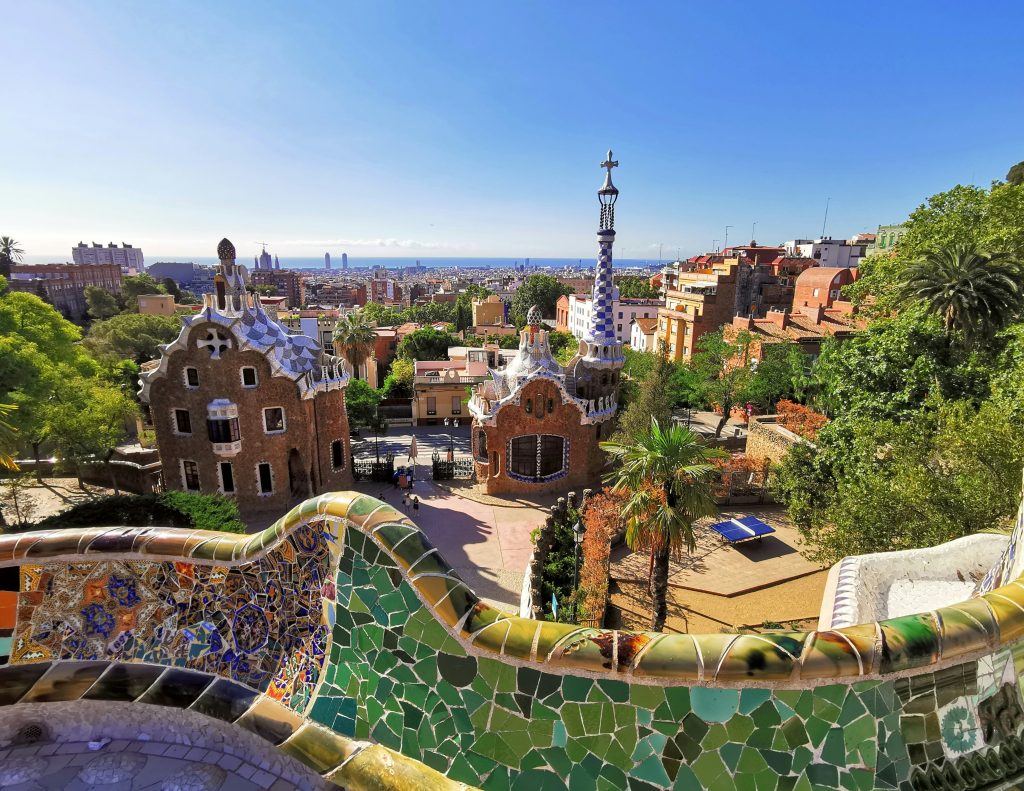
End the day at Park Güell, Gaudí’s terraced garden complex in the hills above the city. The monumental area (€10, timed entry, book ahead) includes the famous mosaic terrace with panoramic views over Barcelona and the sea.
The best time to visit is late afternoon, when the light turns golden and the city below starts to glow.
After Park Güell, drive back down to the Eixample neighbourhood for dinner. Parking Pizza on Carrer de Londres is excellent if you want something informal; Bar Calders in the Sant Antoni neighbourhood is good for evening tapas with a local crowd.
Day 3: Montserrat Day Trip & Barceloneta
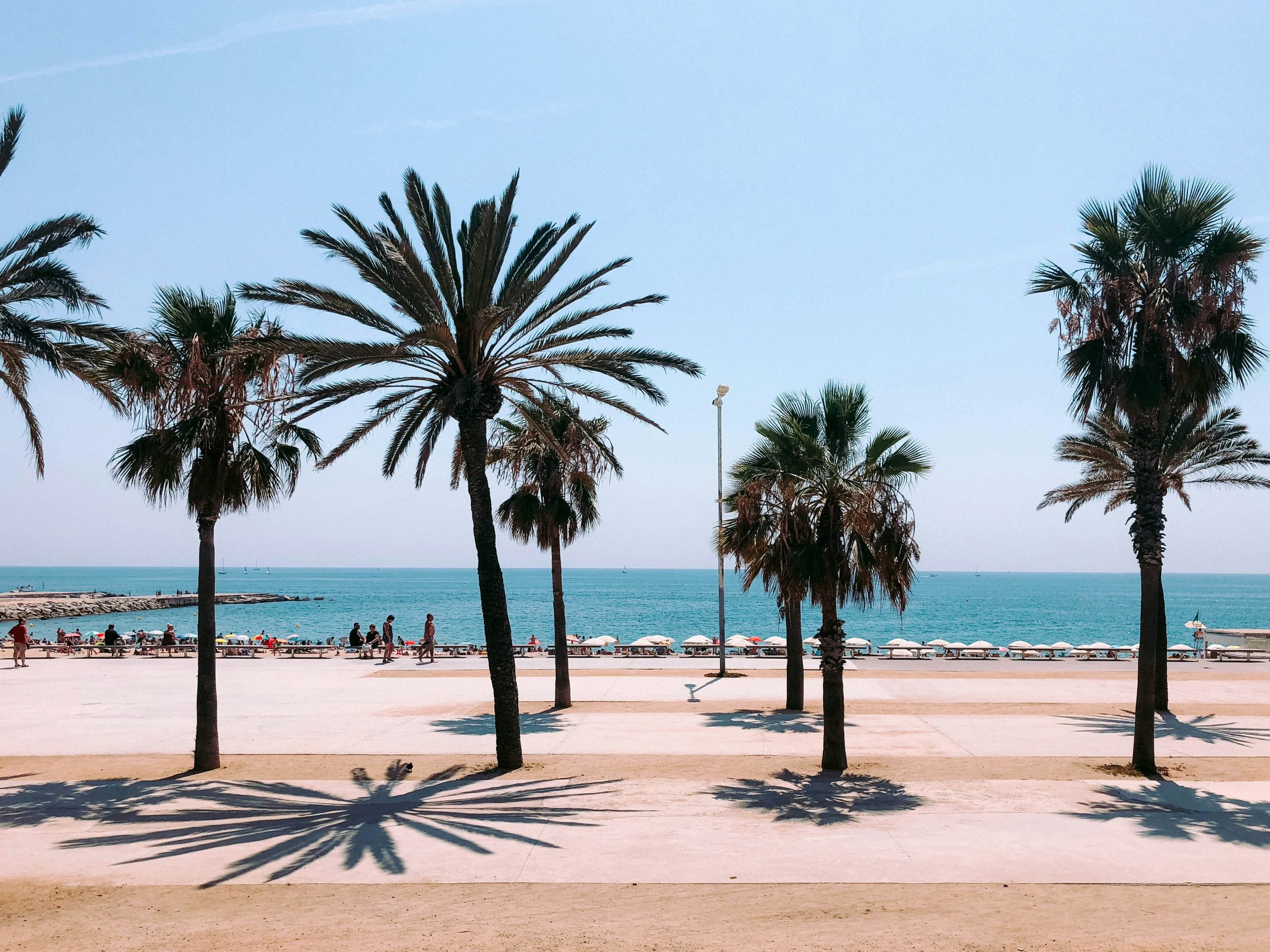
Morning (8:30 AM): Montserrat
About 50km northwest of Barcelona, Montserrat is one of the most distinctive natural landscapes in Catalonia. The massif – a collection of serrated rock peaks rising from the plain, is home to a Benedictine monastery founded in the 9th century, the revered Black Madonna statue, and a network of hiking trails that take you high above the valley.
Drive to the mountain base and take the rack railway (Cremallera) up to the monastery. The ride itself is worth doing for the views. From the monastery, the Sant Joan trail (2km, moderate) takes you to a hermitage 300m above and gives you views across to the Pyrenees on a clear day.
The monastery’s basilica is free to enter. The Black Madonna (La Moreneta) is displayed above the high altar and draws pilgrims from across Spain and Latin America; the queue to approach her statue can run 30-40 minutes but moves steadily.
Practical tip: Drive up early, parking at the base fills by 10:00 AM on weekends and public holidays. Arriving by 8:30 AM gives you the mountain largely to yourself before tour groups arrive from Barcelona.
Afternoon (1:00 PM): Drive Back & Barceloneta
Return to Barcelona by 1:00 PM and spend the afternoon differently from the city sightseeing of the previous two days.
Barceloneta beach is Barcelona’s most central beach: a long, sandy arc below the old fishing quarter of the same name. The neighbourhood itself, with its narrow grid of streets and traditional seafood restaurants, is worth a walk before hitting the beach.
For lunch, La Cova Fumada is the birthplace of the bombas (a fried potato and meat croquette) and one of the most authentic seafood spots in the city. It opens early and runs out of food by early afternoon, so make sure to arrive before 1:30 PM.
The afternoon can be spent on the beach, cycling the waterfront boardwalk toward the Forum, or exploring the El Poblenou neighbourhood; Barcelona’s old industrial district, now home to design studios, galleries, and some of the city’s best coffee shops.
Evening (7:00 PM): Farewell to Barcelona
Tonight is your last evening in Barcelona. The La Barceloneta neighbourhood comes alive around sunset – the old fishermen’s bars serve fresh anchovies, grilled fish, and cold beer, and the crowd is a genuine mix of locals and visitors. Bar Leo on Carrer de la Sal is a neighbourhood classic with no frills and excellent fideuà (Catalan noodle paella).
After dinner, walk along the Passeig Marítim as the city lights up along the waterfront. Tomorrow you leave Barcelona, heading west into the interior of Spain.
Day 4: Drive to Zaragoza
Morning (9:00 AM): Leave Barcelona
Today is a driving day, but a purposeful one. Zaragoza sits roughly 300km southwest of Barcelona on the A-2 motorway; about 3 hours without stops – and it’s one of the most underrated cities on the Spanish mainland.
Most 10 day Spain itineraries skip Zaragoza entirely in favor of going straight to Madrid. That’s understandable, but it means missing one of Spain’s most architecturally interesting cities, the capital of the old Crown of Aragon, and a place where Moorish, Christian, and Jewish histories intersect in a genuinely tangible way.
The drive through Catalonia and into Aragon is scenic rather than spectacular. Stop at a motorway service area in the Monegros Desert region; the landscape shifts dramatically from the green Catalan foothills to a wide, flat semi-arid plain that feels completely different from the Spain you left in Barcelona.
Afternoon (1:00 PM): Zaragoza
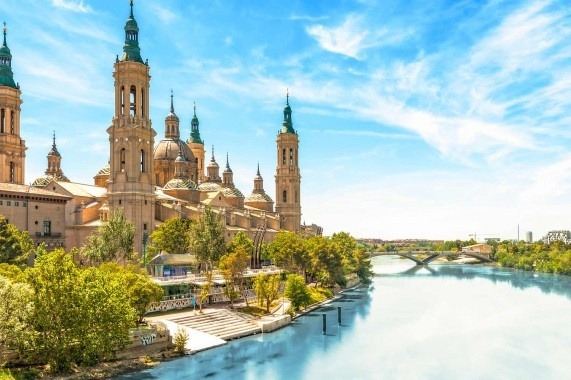
The Basílica del Pilar dominates Zaragoza’s skyline the moment you enter the city. Eleven domes over the River Ebro, the basilica is Spain’s most visited pilgrimage site and one of the finest Baroque buildings in the country. Entry is free; the elevator to the dome roof costs €5 and gives excellent views over the city and the Ebro plain.
A 10-minute walk away is the Aljafería Palace, an 11th-century Moorish fortified palace built by the Moorish rulers of Zaragoza before the Christian Reconquista. The palace’s Islamic art, intricately carved arches, and gold-and-blue tile work are a preview of what you’ll see in Andalusia, though the Aljafería is less visited and feels more personal. Admission is €5.
For lunch, Taberna Doña Casta on Calle Estébanes is a local institution serving ternasco de Aragón; milk-fed lamb roasted until the skin crisps, which is the regional dish Zaragoza is proudest of.
Evening (6:00 PM): Zaragoza Old City
After lunch, walk through Zaragoza’s compact old city: El Tubo, the maze of narrow tapas bars in the old town, is exactly the right place to spend an evening. The city’s tapas culture is less polished than Barcelona’s and more relaxed; small plates of jamón, cheese, bacalao, and morcilla pass over a zinc bar, with a glass of local Cariñena wine.
Camp at one of the sites along the Ebro river or at the municipal campsite near the city. Zaragoza is often overlooked, but it rewards travelers who stop, and it sets the scene for the Moorish architecture you’ll encounter increasingly as you move south.
Day 5: Arrive in Madrid
Morning (9:00 AM): Drive to Madrid
From Zaragoza, Madrid is roughly 300km southwest, about 3 hours on the A-2. The approach to Madrid through the meseta central (central plateau) gives you the flat, dry landscape of Castile that forms the emotional heart of much Spanish history and literature.
Pick up a campsite at Camping Osuna in Madrid, close to the airport and with good metro connections into the center. It’s the most conveniently located campsite for a campervan visit to the capital.
Afternoon (1:30 PM): Puerta del Sol & Plaza Mayor
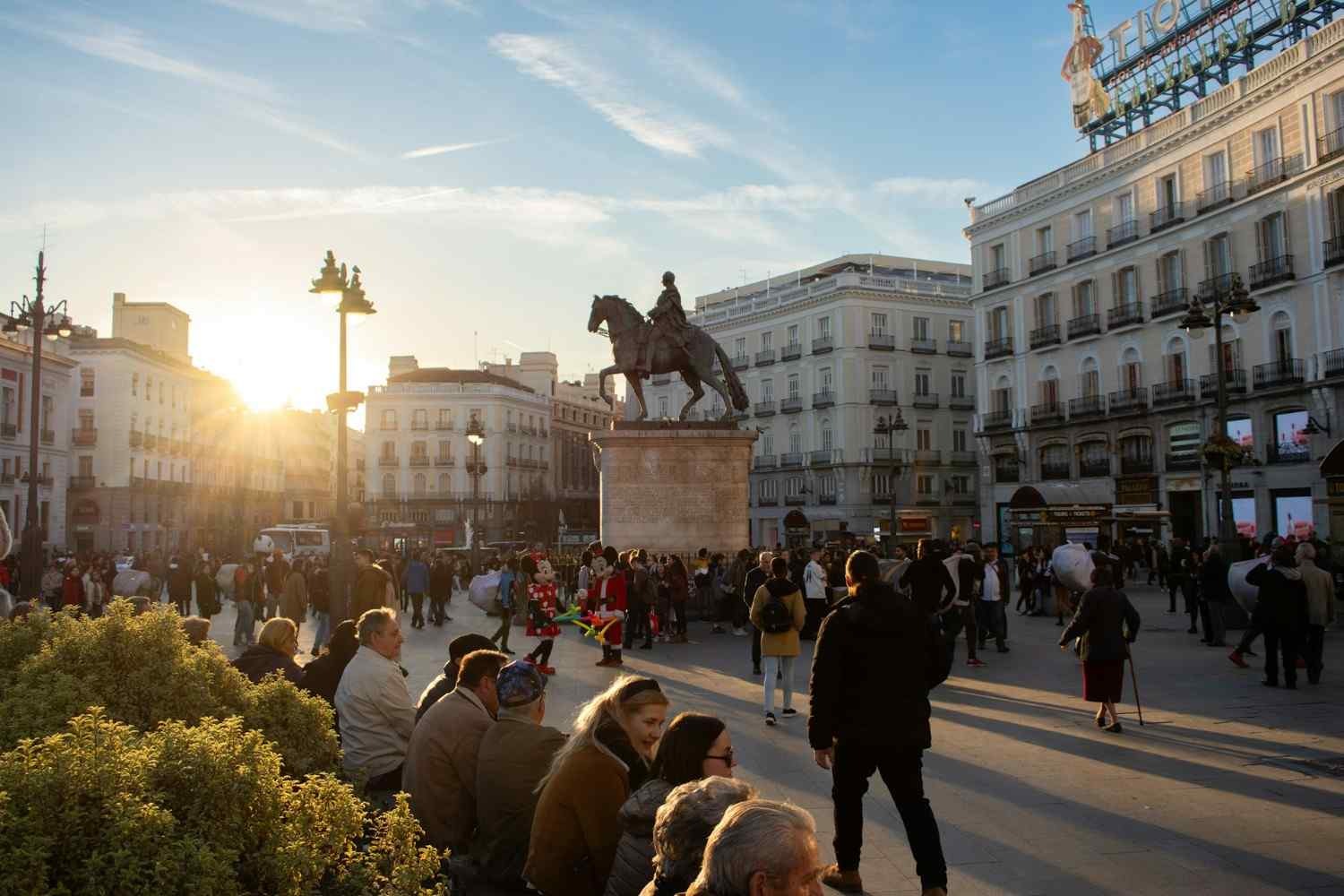
Arrive in the city center by early afternoon. Start at Puerta del Sol, the geographic center of Spain (there’s a plaque marking Kilometer Zero on the pavement) and one of the busiest squares in the country. From here, everything in Madrid’s historic center is walkable.
Walk five minutes west to Plaza Mayor, the grand 17th-century square that served as Madrid’s main public space for royal celebrations, bullfights, and markets. The nine identical arched gates, the painted Casa de la Panadería, and the equestrian statue of Felipe III in the center make it one of the most photogenic squares in Europe.
Just outside Plaza Mayor, stop at Mercado de San Miguel for lunch, a covered iron-and-glass market from 1916 filled with tapas stands serving everything from oysters to Iberian cured meats to vermouth. The prices are tourist-level, but the quality is high and the atmosphere is excellent.
Practical tip: The bocadillo de calamares; a fried squid ring sandwich — is Madrid’s great street food tradition. The best version is at Bar La Campana on Calle Botoneras, around the corner from Plaza Mayor.
Evening (7:00 PM): La Latina & Tapas
For evening, walk down to La Latina – the neighbourhood directly south of Plaza Mayor and Madrid’s best area for traditional tapas bars. Calle de la Cava Baja and Calle del Almendro are lined end to end with cervecerías and tabernas serving vermouth, cold beer, and small plates.
Taberna Txakolina on Cava Baja is a reliable, always-busy pintxos bar with a long bar covered in small plates. Juana La Loca on Plaza de la Puerta de Moros does excellent modern tapas and has one of the best tortilla de patatas in the neighbourhood.
Madrid’s evening starts late. Dinner before 9:00 PM is considered early by local standards, and the best tapas bar energy is between 9:00 PM and midnight.
Day 6: Royal Palace, El Retiro & the Prado
Morning (9:30 AM): Royal Palace of Madrid
Madrid’s second full day covers the three sites that define the city’s cultural identity.
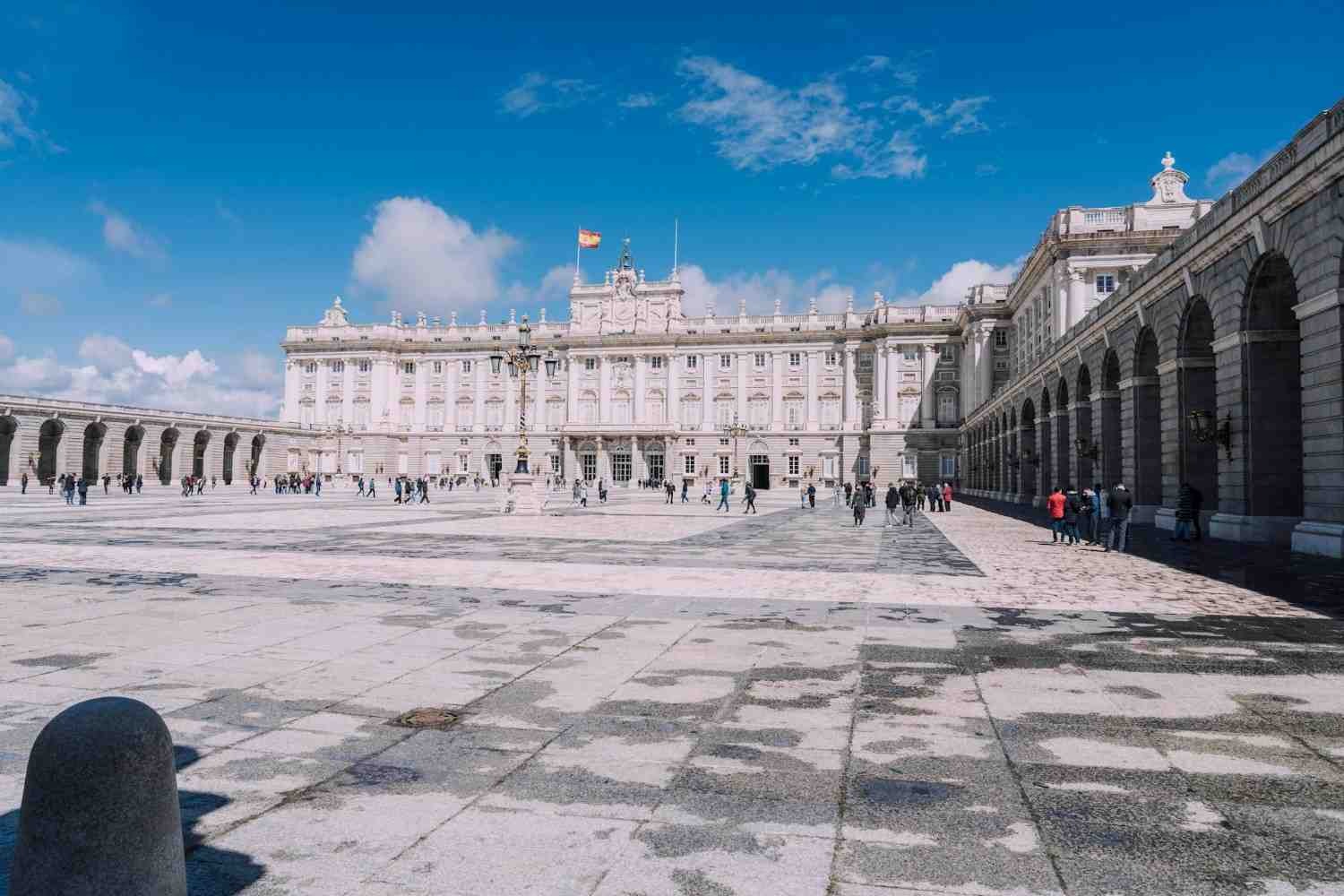
Start at the Royal Palace of Madrid (Palacio Real), the largest royal palace in Western Europe by floor area, with 3,418 rooms, though only about 50 are open to the public. The State Rooms are a display of Bourbon royal excess: ceilings painted by Tiepolo, a dining table set for 140, a weapons collection that spans five centuries, and the Throne Room with its Venetian mirrors and crimson velvet.
Tickets are €14 (€7 with EU citizenship). The palace opens at 10:00 AM; arrive early to beat the tour groups that arrive from 11:00 AM onward.
Directly next to the palace, the Almudena Cathedral is Spain’s newest major cathedral, consecrated in 1993 despite construction beginning in 1879. The interior is noticeably lighter and more modern than Spain’s older cathedrals, and the crypt below is worth seeing separately.
Afternoon (1:30 PM): El Retiro Park & Lunch
After the palace, walk east toward El Retiro Park, Madrid’s great public green space, 350 acres of formal gardens, boating lake, glass-and-iron exhibition buildings, and tree-lined promenades. The Crystal Palace (Palacio de Cristal), a 19th-century glasshouse now used as an art exhibition space, is one of the most beautiful buildings in Madrid and free to enter.
For lunch in the area around El Retiro, Malacatín on Calle de Ruda is the place to try cocido madrileño; Madrid’s defining dish, a slow-cooked chickpea and meat stew served in two courses: broth first, then the solid ingredients. It’s a heavy, deeply satisfying lunch that sets you up for an afternoon of museum walking.
Evening (4:00 PM): The Prado Museum
The Prado Museum is one of the great art museums in the world. The collection covers Velázquez, Goya, El Greco, Rubens, Titian, and Hieronymus Bosch – 8,000 works across three floors, with roughly 1,300 on permanent display.
The most important works to seek out: Velázquez’s Las Meninas (Room 12), Goya’s Black Paintings (Room 67), El Greco’s The Nobleman with his Hand on his Chest, and Bosch’s The Garden of Earthly Delights. Allow 2-3 hours minimum. Adult tickets are €15; book online. The museum is free after 6:00 PM (last entry 7:00 PM), the evening queue is significant but moves fast.
For dinner, the Barrio de las Letras neighbourhood around the Prado is excellent. Estado Puro on the Plaza Cánovas del Castillo serves creative tapas in a modern setting; for something more traditional, Casa Labra off the Puerta del Sol has been serving bacalao (salt cod) in the same spot since 1860.
Day 7: Toledo & Córdoba
Morning (8:30 AM): Toledo
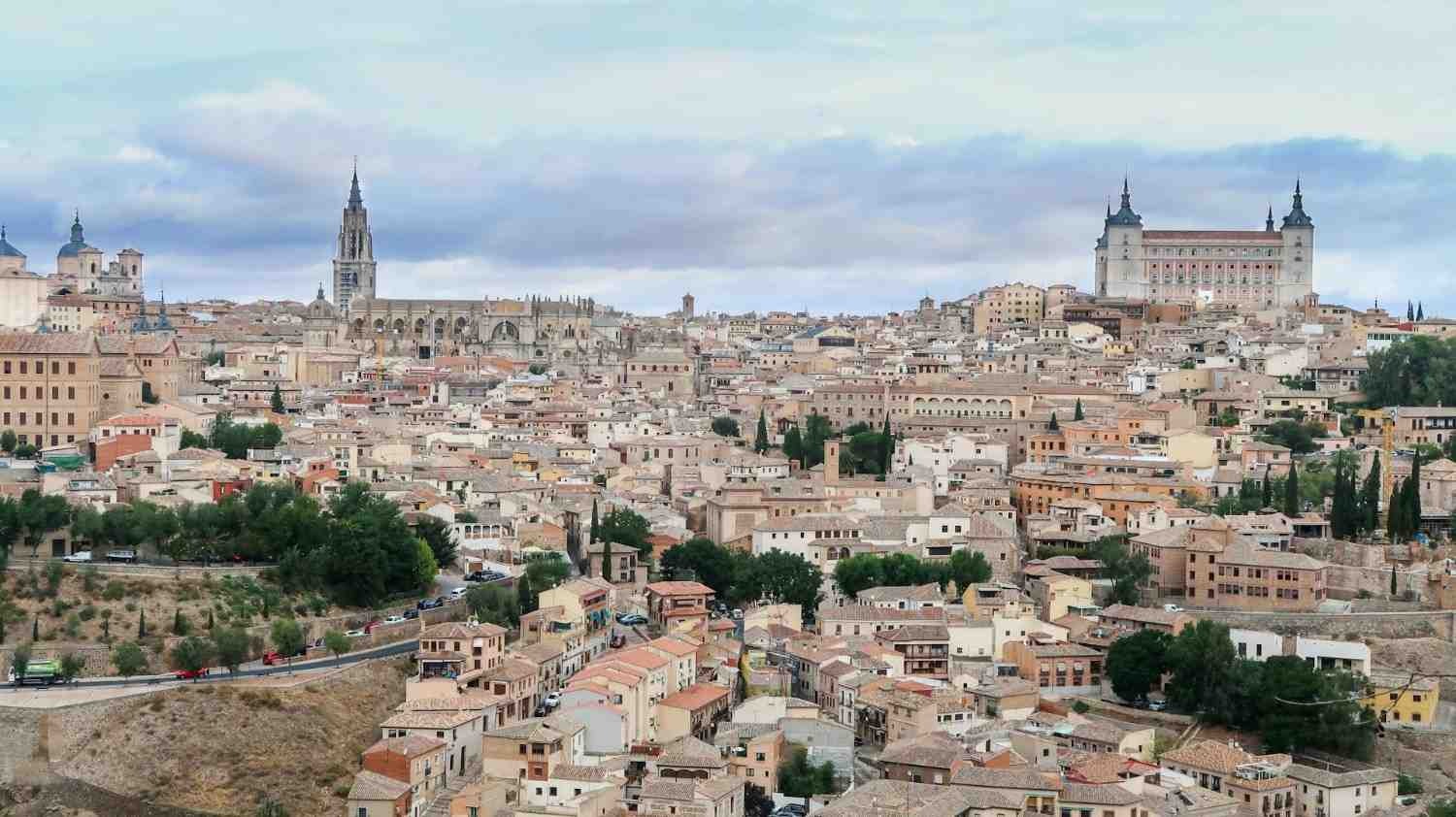
From Madrid, it’s 70km south to Toledo on the A-42 motorway – about 45 minutes. Toledo was the imperial capital of Spain before Madrid and served as the meeting point of Christian, Muslim, and Jewish cultures for centuries. The old city, wrapped in a bend of the Tagus River, is a UNESCO World Heritage Site and one of the most intact medieval cities in Europe.
The key sites are within walking distance of each other. The Toledo Cathedral (€10) is one of the finest Gothic cathedrals in Spain, with a sacristy full of El Greco paintings and a 16th-century choir carved in extraordinary detail. The Sinagoga del Tránsito (€3) is a 14th-century synagogue now serving as a museum of Sephardic Jewish history, one of the finest examples of Mudéjar architecture in Castile.
Practical tip: Toledo is packed with day-trippers from Madrid between 11:00 AM and 5:00 PM. Arriving by 8:30-9:00 AM means you have the city largely to yourself for the first two hours.
Afternoon (2:00 PM): Drive to Córdoba
After Toledo, get back on the road south. Córdoba is roughly 330km from Toledo, about 3 hours on the A-4.
You’ll then arrive in Córdoba in the late afternoon. The star attraction is the Mezquita-Catedral de Córdoba, a 10th-century mosque of extraordinary scale and beauty, into which a Christian cathedral was inserted in the 16th century.
The combination is architecturally bizarre and historically fascinating. Walk through the forest of 856 red-and-white striped arches, then into the Renaissance nave inserted at its center. Adult tickets are €13; the site opens at 8:30 AM for morning prayer at a reduced rate.
For dinner, the Judería (Jewish Quarter) around the Mezquita is packed with tapas restaurants. El Churrasco on Calle Romero is one of the best traditional restaurants in the city – the Salmorejo (a cold, thick tomato soup topped with jamón and hard-boiled egg) is better here than almost anywhere else.
Camp at Camping Municipal de Córdoba, a clean and well-positioned campsite 2km from the old city.
Day 8: Seville
Morning (8:00 AM): Drive to Seville
From Córdoba, Seville is just 140km southwest, about 1.5 hours on the A-4. Arrive in the morning and head straight to the old city.
The Royal Alcázar of Seville (Reales Alcázares) is the must-do of the city and one of the most extraordinary buildings in Spain. Originally a Moorish palace, it was expanded and modified by Christian kings after the Reconquista, producing a layered combination of Islamic and Gothic architecture. The muqarnas ceilings, tiled courtyards, and formal Andalusian gardens are genuinely stunning. Tickets are €14.50; book at least a week ahead – the Alcázar sells out regularly. Opening time is 9:30 AM; the first slot of the day has the most peaceful atmosphere.
Practical tip: The Alcázar is used as a filming location for Game of Thrones (as the Water Gardens of Dorne). This is either a reason to visit or a piece of context you can ignore entirely; the architecture stands on its own.
Afternoon (1:00 PM): Seville Cathedral & Giralda Tower
After the Alcázar, walk directly to the Seville Cathedral, the largest Gothic cathedral in the world and the third largest church of any kind, after St. Peter’s in Rome and St. Paul’s in London. Christopher Columbus is buried here.
The Giralda Tower (originally a minaret, converted to a bell tower in the 16th century) offers views over the entire city from 104m – the ascent is via ramps rather than stairs, making it accessible and worth the climb.
Combined tickets for the cathedral and Giralda are €12 (online); book ahead to avoid the walk-up queue.
For lunch, find a spot in the Santa Cruz neighbourhood – the old Jewish Quarter, now a maze of whitewashed lanes, orange trees, and flower-covered patios. Bar El Rincón de Frasquita on Calle Mateos Gago is a reliably good neighbourhood bar. Try espinacas con garbanzos, a mix of spinach and chickpeas in a spiced tomato sauce – which is also one of Seville’s most characteristic tapas dishes.
Evening (7:00 PM): Plaza de España & Flamenco
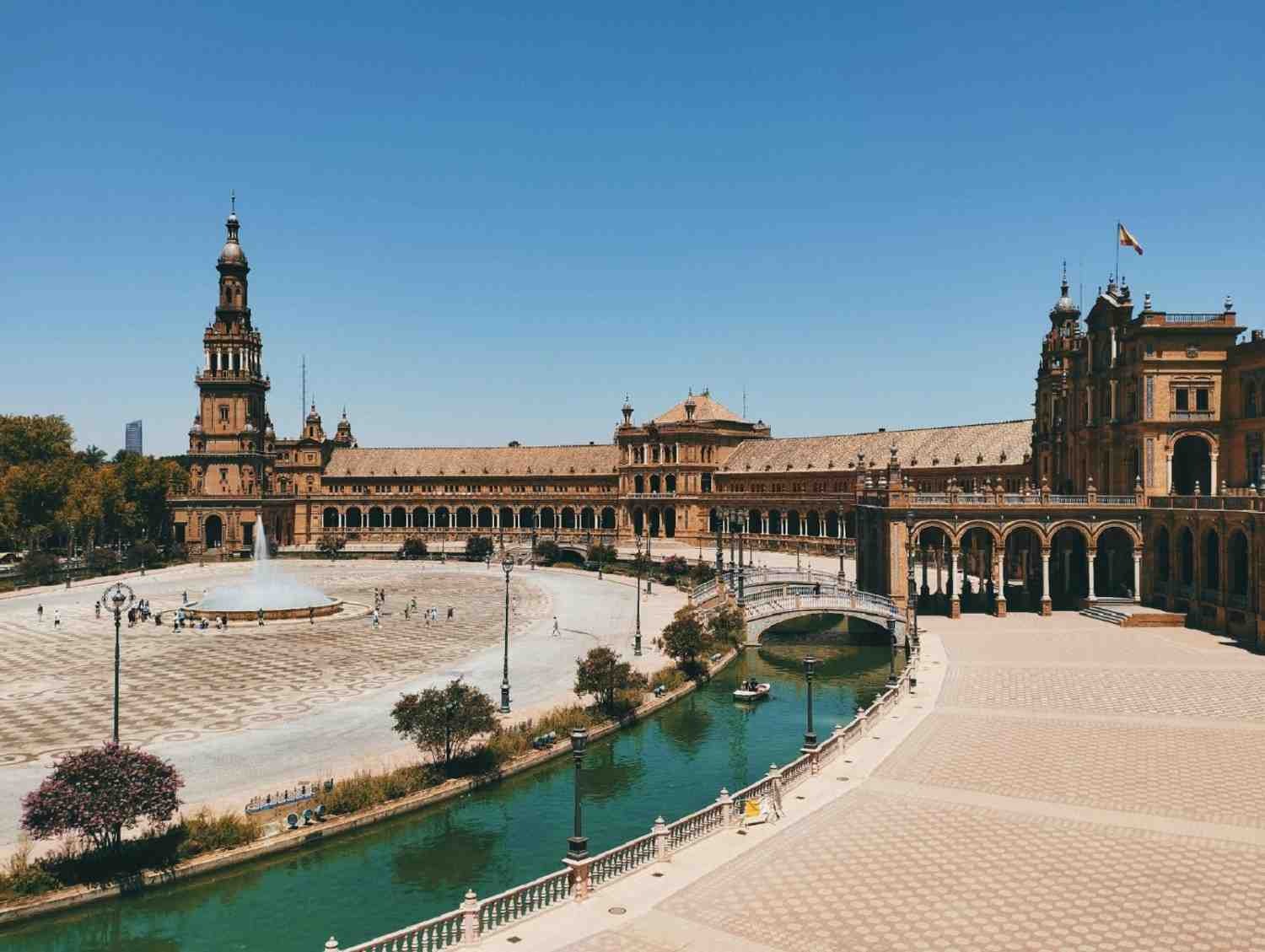
Next up, spend the late afternoon at Plaza de España, a semicircular Baroque-Revival plaza built for the 1929 Ibero-American Exposition, tiled in regional ceramics and ringed by a canal with rowing boats. It’s one of the most visually impressive public spaces in Spain and entry is free.
For the evening, book a flamenco show at one of Seville’s serious tablaos. Tablao El Arenal and Casa de la Memoria both offer high-quality performances that last around 70-90 minutes; tickets run €28-€40 depending on whether dinner is included. Flamenco in Seville is the real thing; rooted in the Triana neighbourhood across the river, and seeing it here in a proper venue is one of the genuine experiences of any Spain itinerary 10 days or longer.
Day 9: Ronda & the White Villages
Morning (9:00 AM): Drive to Ronda
From Seville, it’s about 130km south to Ronda, roughly 2 hours on the A-92, passing through rolling olive groves and the first Andalusian hill towns.
Ronda is one of the most dramatically situated cities in Spain. The old town sits on a mesa 750m above sea level, split from the newer town by the El Tajo gorge – a 120m-deep chasm spanned by the Puente Nuevo bridge, an 18th-century structure that has become one of the most photographed spots in Andalusia.
Walk the Puente Nuevo and look down, the gorge views are extraordinary. The old city (La Ciudad) on the far side of the bridge contains the Arab Baths (€4.50), the old bullring (Plaza de Toros, one of the oldest in Spain, €10 with museum), and a network of steep, cobbled streets lined with whitewashed buildings and flower pots.
Practical tip: Ronda is a day-tripper destination from the Costa del Sol, which means it fills between 11:00 AM and 4:00 PM. Arriving early in the morning lets you photograph the Puente Nuevo without crowds and explore the old town before the tour buses arrive.
Afternoon (2:00 PM): Pueblos Blancos Drive
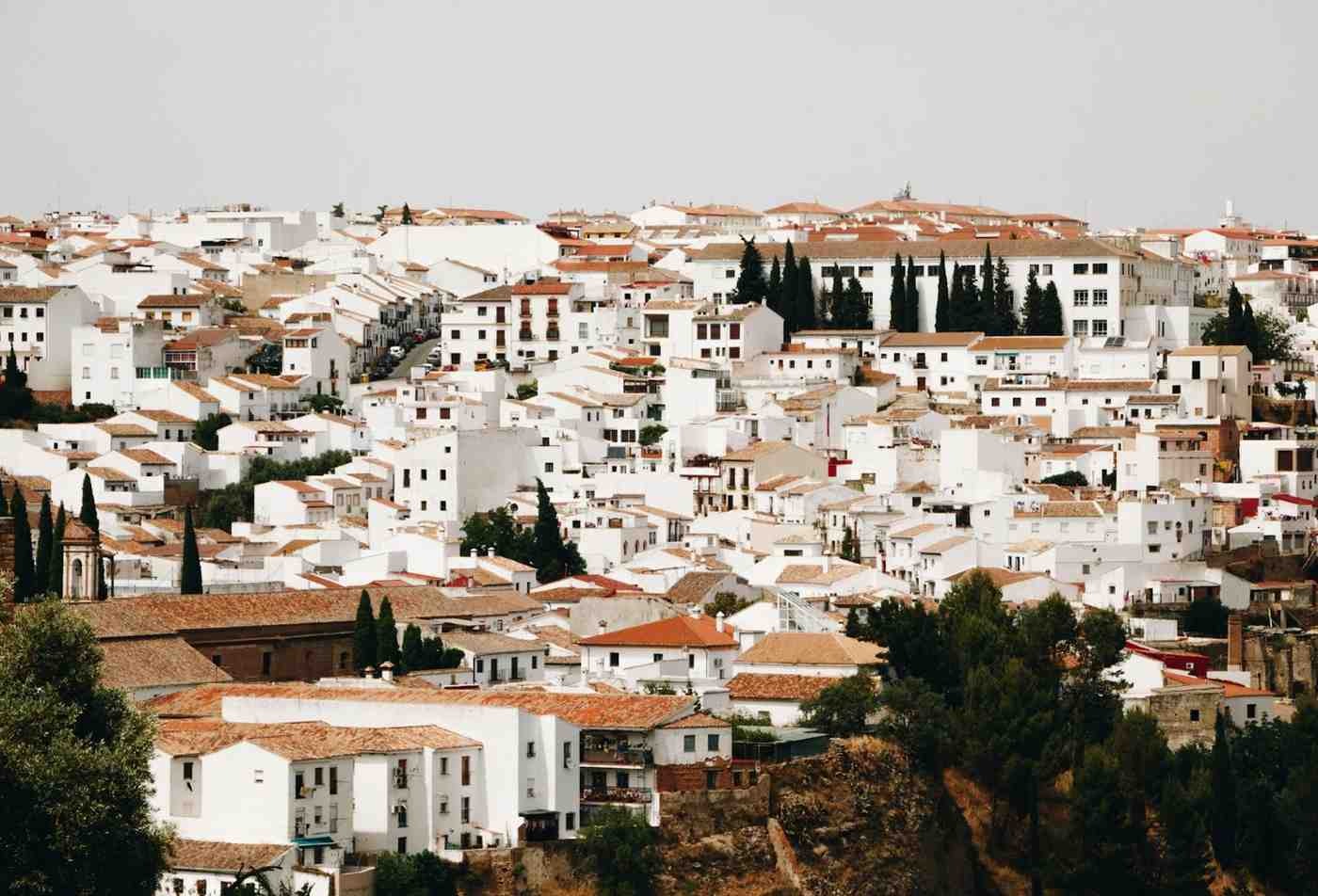
After Ronda, take the afternoon to drive through the Pueblos Blancos, the chain of whitewashed hill villages that runs northeast from Ronda through the Sierra de Cádiz toward Arcos de la Frontera.
This stretch of road is one of the most visually distinctive drives in Spain. Villages like Zahara de la Sierra, Grazalema, and Olvera cling to rocky outcrops, their white walls visible from kilometres away against the green and brown sierra.
Stop at least two. Zahara de la Sierra has a Moorish castle accessible via a short hike; Grazalema is in the wettest corner of Spain (receiving over 2,000mm of rain per year) and surrounded by cork oak forest.
For lunch in the villages, try rabo de toro (oxtail stew, slow-cooked with wine and vegetables) – a staple dish of this region and one of the most satisfying things you’ll eat in Andalusia.
Evening (6:00 PM): Camp in the Sierra
Camp for the night in or around the Pueblos Blancos region. Camping Tajo Rodillo near Zahara de la Sierra is a small site with mountain views and a good pool in summer.
This part of Andalusia is genuinely rural; the evenings are quiet, the skies are dark, and the food in the village restaurants is exceptionally local.
Day 10: Granada & the Alhambra
Morning (8:30 AM): Drive to Granada
Granada is roughly 180km east of Ronda, about 2.5 hours through the mountains via the A-374 and A-92. The route crosses the Sierra de Ronda and drops into the Vega de Granada – the fertile plain below the Sierra Nevada, with views of snow-capped mountains ahead.
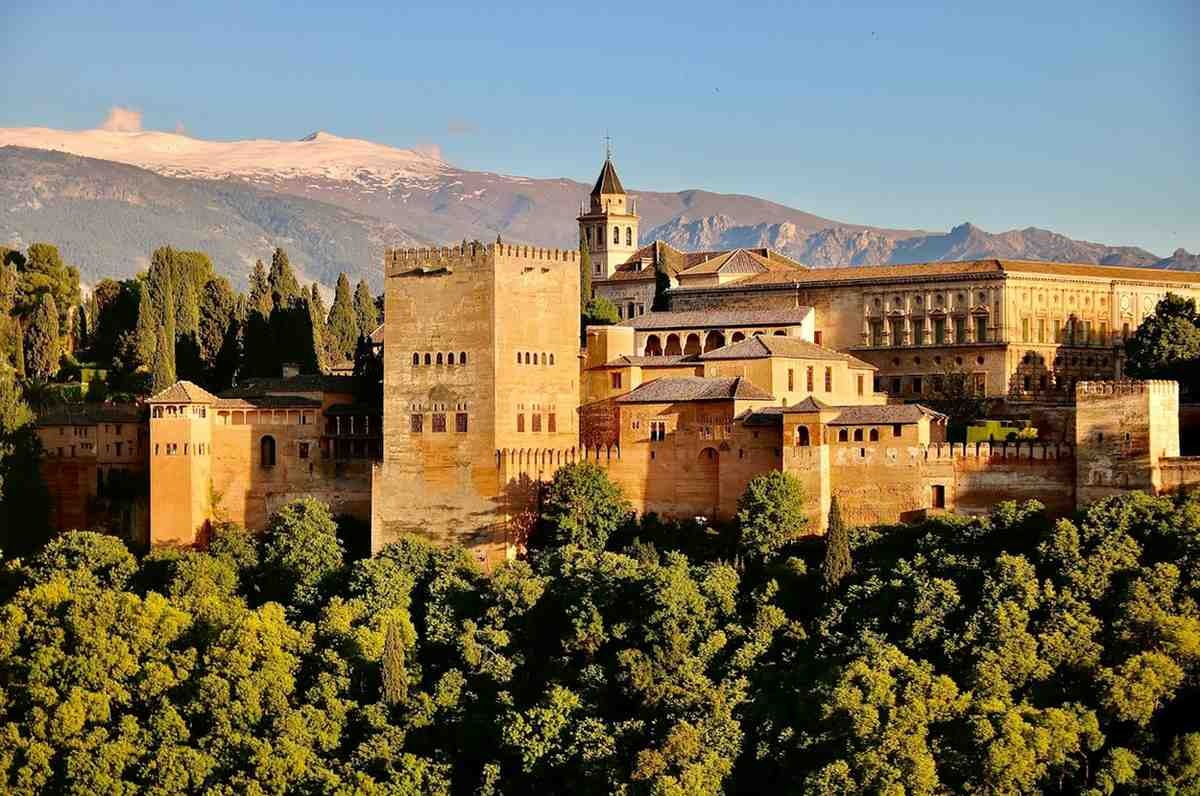
The Alhambra is the most visited monument in Spain and one of the most significant surviving examples of Islamic architecture anywhere in the world. The complex includes three main areas: the Nasrid Palaces (the most important, with muqarnas ceilings, carved stucco walls, and reflecting pools), the Alcazaba (the original Moorish fortress with panoramic views), and the Generalife gardens (summer palace and terraced gardens above the main complex).
Book tickets 2-3 months in advance if you’re visiting in spring or summer. Entry is timed and strictly controlled: €19 for the full complex, with the Nasrid Palaces on a separate 30-minute entry slot. Do not miss the booking step, since the Alhambra genuinely sells out weeks ahead.
Practical tip: The Nasrid Palace night visit (€10, separate booking) is one of the most atmospheric experiences in Spain; the palace lit at night with almost no other visitors. Available Tuesday-Saturday and worth adding if your schedule allows.
Afternoon (1:30 PM): Albaicín Quarter
After the Alhambra, cross the river into the Albaicín, Granada’s old Moorish neighbourhood of whitewashed houses, narrow lanes, and Arabic tea houses (teterías). The quarter climbs the hill opposite the Alhambra and offers the city’s most celebrated viewpoint: the Mirador de San Nicolás, looking directly at the Alhambra palace against the backdrop of the Sierra Nevada.
For lunch, find a tetería in the Albaicín and order a pot of mint tea with pastries, then find a proper restaurant for tortilla sacromonte – Granada’s local omelette made with offal, vegetables, and eggs, a dish with roots in the Romani Sacromonte neighbourhood nearby.
Evening (7:00 PM): Flamenco in the Sacromonte Caves
Granada’s flamenco tradition is tied to the Sacromonte caves, a hillside neighbourhood where Romani families have lived for centuries and where some of the oldest flamenco in Spain originated.
Cave shows here are more intimate than the Seville tablaos and often feel more raw: small rooms carved into the hillside, lit by candles, with dancers performing within touching distance.
Zambra María la Canastera is one of the most respected venues. Tickets run €20-€30; shows start at 10:00 PM. Dinner beforehand in the Bib-Rambla area near the cathedral – Restaurante Ruta del Azafrán does excellent Granada-style dishes in a relaxed setting.
This is the final night of a Spain itinerary 10 days long that has taken you from Gaudí’s Barcelona to flamenco caves in the Andalusian hills. Spain delivers on every stop along the way.
Exploring Spain’s Regions: Alternative Itineraries
The 10 day Spain itinerary above follows a classic north-to-south route. If you want to focus on one region more deeply, or if you’re returning to Spain and have already covered the main cities, here are two strong alternative approaches.
10-Day Northern Spain Itinerary
- Day 1-2: Start in San Sebastián, spend two days exploring the Old Town, eating pintxos along Calle 31 de Agosto, and relaxing on La Concha beach.
- Day 3: Drive to Bilbao to visit the Guggenheim Museum, walk through the Casco Viejo, and eat your way through the city’s ‘Txoko’ (pronounced: ‘chokko’) dining culture.
- Day 4: Head into La Rioja for a day among the vineyards, visit the bodegas around Haro and end the evening on Logroño’s famous tapas street, Calle Laurel.
- Day 5: Continue south to Burgos to see the Gothic cathedral and the Cartuja de Miraflores monastery, one of the finest examples of Isabelline Gothic architecture in Spain.
- Day 6-7: Drive west to Santiago de Compostela for two nights; walk the final stretch of the Camino, visit the Cathedral, and eat fresh Galician seafood in the old city.
- Day 8: Head east along the Asturian coast, stopping at the Picos de Europa national park and the glacial Covadonga lakes above the tree line.
- Day 9: Continue into Cantabria, visiting the Altamira cave art replica near Santillana del Mar and driving the dramatic coastal cliffs toward Santander.
- Day 10: Return to San Sebastián for a final morning of pintxos and a glass of txakoli before departing.
10-Day Southern Spain (Andalusia Only) Itinerary
- Day 1-2: Begin in Seville with two full days covering the Royal Alcázar, the Cathedral and Giralda Tower, an evening flamenco show, and a walk through the Triana neighbourhood across the Guadalquivir river.
- Day 3: Drive to Córdoba to visit the Mezquita-Catedral, explore the narrow lanes of the Jewish Quarter, and try the city’s signature Salmorejo at a bar near the old city walls.
- Day 4: Head northeast to Jaén, a largely overlooked provincial capital sitting above the world’s largest olive oil producing region, with the Castillo de Santa Catalina offering panoramic views over the olive groves below.
- Day 5-6: Spend two nights in Granada, dedicating the first day to the Alhambra (book 2-3 months ahead) and the second to the Albaicín quarter, the Mirador de San Nicolás viewpoint, and an evening flamenco show in the Sacromonte caves.
- Day 7: Drive southeast to Almería and spend the day in Cabo de Gata natural park – a.k.a Spain’s driest corner, with volcanic coastline, deserted beaches, and a landscape that doubles as a film set for countless Spaghetti Westerns.
- Day 8: Continue west to Málaga, visiting the Picasso birthplace museum, walking the port and Muelle Uno, and eating fresh fried fish at one of the chiringuitos at El Palo beach.
- Day 9: Head inland to Ronda to see the Puente Nuevo gorge and the old bullring, then drive the Pueblos Blancos route through Zahara de la Sierra and Grazalema before camping in the sierra.
- Day 10: End the route in Cádiz, the oldest continuously inhabited city in Western Europe, with a morning walk around the Atlantic-facing sea walls, a visit to a sherry bodega in nearby Jerez, and a final afternoon on the wide, white-sand beaches facing the open Atlantic.
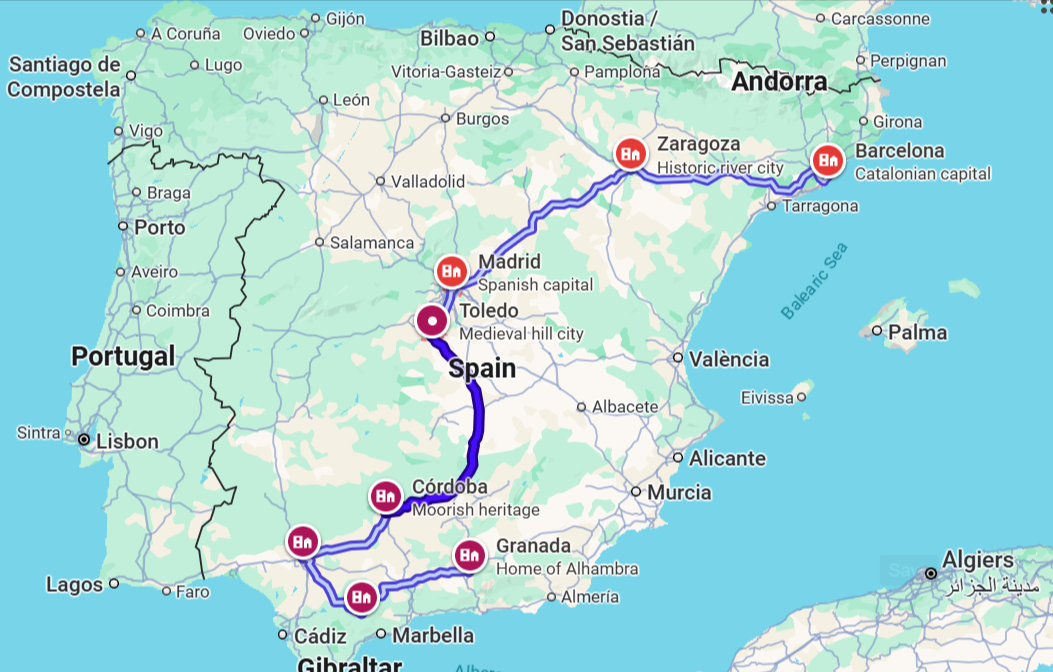
Map of Your 10-Day Spain Itinerary
Budgeting for Your Trip: How Much Does 10 Days in Spain Cost?
A campervan road trip through Spain is one of the most cost-effective ways to travel the country – and that matters, because Spain’s major city attractions; particularly the Alhambra, Sagrada Família, and Alcázar, all carry meaningful entry fees that add up over 10 days.
Here’s a realistic per-person daily breakdown for a 10 day Spain itinerary, excluding the cost of the RV rental itself:
| Category | Budget | Mid-Range | High-End |
| Accommodation (Campsites) | €10-€20 | €20-€35 | N/A |
| Food & Drink | €25-€40 | €45-€70 | €90+ |
| Attractions & Activities | €20-€35 | €40-€60 | €80+ |
| Fuel & Tolls (Split) | €15-€25 | €25-€35 | €35+ |
| Daily Total | €70-€120 | €130-€200 | €205+ |
| 10-Day Total | ~€700-€1,200 | ~€1,300-€2,000 | €2,050+ |
- Budget Traveler: You’ll cook most meals in the campervan, stay at municipal campsites (€10-€20 per night), and choose free or low-cost activities – many of Spain’s best experiences cost nothing or very little, including the Gothic Quarter, El Retiro Park, the Albaicín viewpoint, and the Pueblos Blancos drive. The main paid attractions you really shouldn’t skip are the Alhambra (€19), Sagrada Família (€26-€36), and the Royal Alcázar of Seville (€14.50).
- Mid-Range Traveler: You’ll eat out once or twice a day at local tapas bars and restaurants, stay at well-equipped campsites with showers and facilities, and visit all the major paid attractions. A typical mid-range day runs €130-€200 per person, covering a full day of activities, meals out, and a comfortable campsite.
- High-End Traveler: You’ll dine at restaurants rather than tapas bars, add experiences like private Alhambra night visits, a flamenco dinner show, or a Segovia day trip from Madrid, and stay at a mix of campsites and paradores (Spain’s state-run heritage hotels) when you want a different kind of overnight. Budget €200+ per person per day for this level of travel.
Plan Your Spain Road Trip with Indie Campers
A Spain itinerary 10 days long covers a lot of ground, roughly 1,500km from Barcelona to Granada. The most practical way to do that route is with a campervan that moves when you move and parks where you want to park.
Indie Campers has pickup locations across Spain: Barcelona, Madrid, Seville, Malaga, Valencia, Bilbao, and Alicante, which makes a one-way rental for this itinerary completely straightforward. Pick up in Barcelona, drop off in Malaga or Granada. No backtracking, no returning to the start city.
Our fleet covers everything from compact two-berth vans for couples to larger family motorhomes. All of them include unlimited mileage, which becomes crucial when your route adds up to 1,500km. Book now and pay the full amount 30 days before pick-up. Cancel free up to 31 days before your trip if your plans change. 24/7 support too, is available throughout.
For independent travelers who want to set their own schedule, families who want flexibility without nightly hotel logistics, and first-time campervan renters who want a reliable and digitally managed booking process, we handle the logistics so you can focus on the drive.
Book your RV rental in Spain with Indie Campers →
10-Day Spain Itinerary: Your Final Planning Recap
| Category | Details |
| Best Time to Go | Spring (April-June) or Autumn (September-October); comfortable temperatures, fewer crowds, and lower prices than summer |
| Recommended Budget | €700-€2,000 per person for 10 days, excluding RV rental |
| Cities & Stops | Barcelona (3 nights), Zaragoza (1 night), Madrid (2 nights), Toledo (half day), Córdoba (1 night), Seville (1 night), Ronda & White Villages (1 night), Granada (1 night) |
| Best Restaurants | El Xampanyet – Barcelona (tapas & cava); Taberna Txakolina – Madrid (pintxos); El Churrasco – Córdoba (salmorejo); Bar El Rincón de Frasquita – Seville (espinacas con garbanzos); Ruta del Azafrán – Granada (local Granadan cuisine) |
| What to Visit | Sagrada Família, Park Güell, Montserrat, Aljafería Palace, Royal Palace Madrid, Prado Museum, El Retiro, Toledo Cathedral, Mezquita-Catedral, Royal Alcázar Seville, Puente Nuevo Ronda, Alhambra |
| Recommended Transport | Campervan rental via Indie Campers — one-way Barcelona to Malaga/Granada, unlimited mileage, DOC campsites and Spanish autocaravana parks throughout |
| Total Distance | Approx. 1,500km (930 miles) |
| Must-Try Foods | Barcelona: pan con tomate, patatas bravas; Madrid: cocido madrileño, bocadillo de calamares; Córdoba: salmorejo; Seville: espinacas con garbanzos; Granada: tortilla sacromonte; Ronda: rabo de toro |
| Accommodation | Spanish campsites and autocaravana parks: €10-€35 per night |
| Perfect For | First-time visitors to Spain wanting to cover Barcelona, Madrid, and Andalusia; road trip enthusiasts; couples and families who want flexibility without hotel logistics |
Frequently Asked Questions (FAQs)
How much does a 10-day trip to Spain cost?
A 10-day trip to Spain costs roughly €1,300-€2,000 per person for a mid-range campervan road trip, covering campsites, food, fuel, and major paid attractions including the Alhambra (€19), Sagrada Família (€26-€36), Royal Alcázar (€14.50), Prado Museum (€15), and the Royal Palace (€14). Budget travelers can manage at around €700-€1,200 by cooking most meals in the campervan and prioritizing free activities. Neither figure includes the RV rental itself, which varies by vehicle size and season.
Is 10 days enough to see Spain?
Yes, a Spain itinerary 10 days long is enough to see the most significant cities and landscapes of mainland Spain on a well-planned route. Following a north-to-south path from Barcelona through Madrid to Andalusia covers three distinct cultural regions: Catalonia, Castile, and Moorish Andalusia, without requiring excessive daily driving. You won’t cover the Basque Country, Galicia, or Valencia on this route, but you’ll experience the experiences most people travel to Spain specifically for.
What are the top 3 places to visit in Spain for first-timers?
The top three places to visit in Spain for first-time visitors are Barcelona, Seville, and Granada. Barcelona offers Gaudí’s architecture, Gothic Quarter history, and the best food scene in Spain; Seville delivers Moorish palaces, flamenco, and Andalusian cuisine at its most characteristic; and Granada gives you the Alhambra, widely considered the finest surviving example of Islamic architecture in the Western world.
What is the most beautiful place in Spain?
The Alhambra in Granada is widely considered the most beautiful place in Spain, a 13th-century Moorish palace complex combining intricate tile work, muqarnas ceilings, carved stucco, and formal gardens overlooking the Sierra Nevada.
What is the best way to travel to Spain in 10 days?
The best way to do a 10 day Spain itinerary is by campervan, following a one-way north-to-south route from Barcelona to Granada or Malaga. This approach combines transport and accommodation into one daily cost, gives you the flexibility to stop at Zaragoza, Toledo, Ronda, and the Pueblos Blancos; destinations the train simply can’t reach – and eliminates the nightly hotel booking logistics across multiple cities. Indie Campers offers one-way rentals across Spain with unlimited mileage on company-owned vehicles.
What is the best route for a 10-day Spain road trip?
The best route for a Spain itinerary 10 days by campervan is: Barcelona (3 nights) → Zaragoza (1 night) → Madrid (2 nights) → Toledo (half day) → Córdoba (1 night) → Seville (1 night) → Ronda and White Villages (1 night) → Granada (1 night). This covers roughly 1,500km from northeast to south, follows a logical geographic path without backtracking, and ends near Malaga Airport for onward flights.
Is Spain safe for solo travelers?
Spain is very safe for solo travelers and consistently ranks among the safest tourist destinations in Europe. Petty theft (particularly bag snatching and pickpocketing) is the most common issue for visitors, concentrated in busy tourist areas like La Rambla in Barcelona and the areas around major Madrid sights. Keep valuables out of back pockets, use a crossbody bag, and don’t leave belongings visible in a parked campervan. Solo campervanning in Spain is common and well-supported by the campsite network, and Spanish locals are generally helpful and hospitable.
Do I need to book Spain attractions in advance?
Yes, advance booking at major attractions is essential when planning a Spain itinerary 10 days long. The Alhambra in Granada sells out 2-3 months ahead in spring and summer; book the moment your dates are confirmed. The Sagrada Família in Barcelona should be booked at least 2-4 weeks ahead. The Royal Alcázar in Seville and the Prado Museum in Madrid are less constrained but benefit from online booking to skip walk-up queues. For flamenco shows in Seville and Granada, book 3-5 days ahead.
Can I drive a campervan in Spain’s city centers?
Driving a campervan into Spain’s major city centers has become more restricted in recent years. Barcelona, Madrid, and Seville all have Low Emission Zones (ZBE in Barcelona, ZBE in Madrid, ZEC in Seville) that restrict older vehicles from entering. Most modern rental campervans from Indie Campers meet the required emission standards, but confirm the vehicle’s environmental badge before driving into restricted zones. In practice, the best approach for this 10-day Spain itinerary is to park the campervan at a well-located campsite and use public transport into the city centers, which is both more practical and less stressful than city driving with a large vehicle.